
The short answer
Choose open-ear earbuds when awareness, comfort and active-use positioning are central to the offer. Choose in-ear earbuds when compactness, acoustic isolation and stronger low-frequency perception are more important. For an OEM buyer, neither architecture is universally better. The right decision follows the target user, wearing environment, price band, fit expectations, required controls, battery plan and retail story. Sample both styles with representative users before committing to packaging and volume.
Define the customer job before comparing specifications
A procurement team should begin with the situation in which the product will be used. Commuters, office users, runners, warehouse staff, gift-program buyers and value retail customers weigh comfort, awareness, isolation and price differently. Write a one-sentence product application statement: who uses it, for how long, in what environment and what problem it solves. This prevents a feature list from replacing a product strategy. It also gives the factory a clearer basis for recommending catalog models.
How open-ear earbuds work
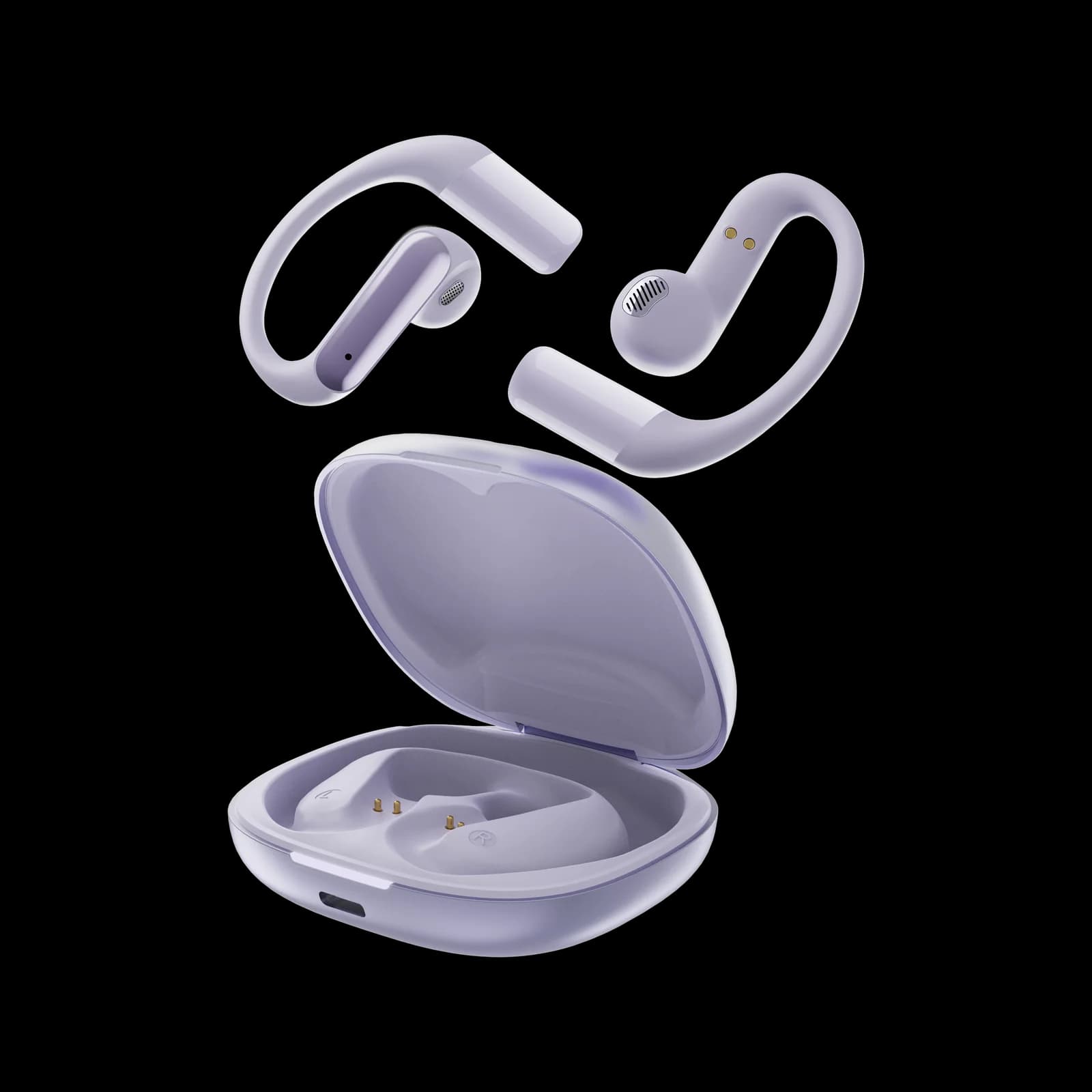
Open-ear products place the sound outlet outside the ear canal. Ear-hook models wrap around the ear, while clip-on models hold the speaker and rear section on opposite sides of the outer ear. The open construction can help users remain aware of surrounding sound and avoids sealing the canal. The tradeoff is that fit and speaker position have a strong influence on perceived sound, and external noise can mask content. Buyers should evaluate both comfort and stable positioning, not treat all open-ear designs as equivalent.
How in-ear earbuds work
In-ear earbuds place a nozzle and ear tip at or near the ear canal. A suitable seal can improve passive isolation and bass perception, allowing a compact form and familiar true-wireless charging case. Fit varies with ear anatomy and tip size, so include appropriate tips and clear instructions. Some users prefer the secure, isolated sensation; others experience pressure or fatigue. A buyer should test the specific shell, nozzle angle, weight and controls rather than relying on the category name alone.
Compare comfort and fit
For long office sessions or users who dislike ear tips, open-ear models may offer a compelling comfort story. Ear hooks distribute weight but must suit different ear shapes and glasses. Clip-on products need enough holding force for stability without creating pressure. In-ear models can feel lighter and more compact, yet the wrong shell or tip can reduce retention. Run a structured wear trial with different users. Record stability during walking and head movement, comfort after extended wear, interference with glasses, and how easily left and right units are identified.
Compare sound, privacy and awareness
In-ear designs generally have an advantage when the goal is passive isolation and consistent bass, provided the seal is correct. Open-ear designs intentionally allow environmental sound, supporting awareness but also allowing more external noise into the listening experience. Sound leakage depends on volume, distance and design; it should be measured or compared under defined conditions rather than described with absolute claims. For voice calls, microphone placement, algorithms and wind handling matter in both categories. Ask for call samples and test in the environments that reflect customer requirements.
Compare battery and charging-case design
Runtime depends on cell capacity, power management, volume, codec, microphone use and firmware. Open-ear housings may have more room for a larger cell, but their case can also be larger because of hooks or clip geometry. In-ear products often support a smaller pocketable case. Compare complete product dimensions and gross weight, not only earbud capacity. Ask the supplier to state the runtime test method. During factory testing, verify charge contact alignment, left/right charging recognition, indicator logic and standby behavior on representative samples.
Compare controls and daily usability
Touch controls can support a clean surface but may be triggered while users adjust an ear hook or clip. Physical buttons provide tactile feedback but add mechanical parts and pressing force. In-ear shells can also move when a button is pressed. Review the control map, long-press timing, volume behavior, call actions, voice assistant access and reset procedure. If voice prompts or Bluetooth names are customized, freeze the exact language and spelling before production.
Compare packaging, logistics and merchandising
Open-ear silhouettes can create strong visual differentiation online and on shelf, while in-ear products are familiar and easier for customers to understand quickly. Case size affects retail carton dimensions, master-carton quantity and freight. Before artwork, obtain a physical packaging mockup and confirm how the earbuds, case, cable, manual and accessories are retained. Installation preparation for a retail program includes barcode placement, destination labels, manual languages, carton marks and drop-test expectations. Shipment inspection should verify all of these against the approved pack.
Match the architecture to the sales channel
A sports-focused direct-to-consumer brand may value an ear-hook product with a clear awareness and stability story. A fashion or youth brand may prefer clip-on geometry and color options. A distributor serving broad electronics retail may favor familiar in-ear models at several price points. Corporate gifting may prioritize logo visibility, packaging customization and simple pairing. These are positioning hypotheses, not guarantees. Validate them with channel partners, product reviews, return reasons and small-batch feedback before expanding the range.
Use a weighted scorecard
Compare candidate models with a scorecard tied to the product brief. Weight each criterion before evaluating samples so a visually impressive model does not override the business requirements. Typical criteria include fit across users, comfort, stability, call quality, perceived sound, case size, runtime method, customization area, packaging efficiency, target-market documentation, lead time and total landed cost. Add a notes field for evidence and unresolved questions. The winning model should have the best fit with the intended offer, not simply the highest number of advertised features.
- User and primary application
- Required awareness or isolation
- Wear stability and comfort
- Audio and call test results
- Case size and packaging efficiency
- Customization and compliance scope
- Target price and expected channel margin
Sample and pilot before the first volume order
Request production-representative samples and identify their hardware and firmware versions. Test pairing, reconnection, controls, charging, calls, music, wear stability and battery behavior using a written checklist. Gather feedback from users who resemble the target customer. If changes are required, classify them as cosmetic, firmware, packaging or structural because each has a different cost and timeline. Approve a golden sample and pilot packaging before mass production. A smaller validation order can reveal returns, fit complaints and instruction gaps that a conference-room review cannot.
Consider return reasons before adding features
A long specification can look competitive while creating support burden. Ask what is most likely to drive a return: uncomfortable fit, confusing controls, unstable pairing, weak call performance, an oversized case or expectations created by inaccurate claims. Then prioritize features that reduce those risks. Multipoint, active noise control, low-latency modes or app functions may be valuable for some segments, but each adds behavior that must be explained and tested. For a value retail program, dependable basic operation and clear instructions may create more commercial value than a crowded feature list.
Plan color and branding around the structure
Open-ear products often expose more surface area and can make a distinctive visual statement, but flexible materials, hinges and textured parts may accept coatings or printing differently. In-ear products offer familiar case branding areas, while the earbuds themselves may have limited flat space. Ask for drawings or measured logo areas and confirm the decoration process, color reference, gloss level and abrasion expectations. Review actual samples under consistent lighting. Packaging renders are useful for selling the concept, but approval should be based on physical material and production-representative decoration.
Compare total landed economics
Unit price is only one input. Include packaging size, master-carton quantity, freight, duties, testing, samples, artwork, tooling if any, inspection, spare units, warranty allowance and channel fees. An open-ear case that occupies more volume may change logistics economics; an in-ear model with multiple tips may add accessory and packing complexity. Compare quotations with the same Incoterm, currency, quantity, specification and packaging assumptions. If one quote excludes compliance support or uses a different battery or chipset, it is not a like-for-like comparison. Record assumptions next to the cost so the lowest number does not hide the highest risk.
Build a category portfolio, not a single winner
Many distributors do not need to choose one architecture for the entire market. A clear range can assign roles: a clip-on open-ear model for fashion and comfort, an ear-hook model for active use, and an in-ear model for compact everyday listening. Avoid too many near-duplicate SKUs at launch. Give each product a distinct audience, price and reason to exist, then track sell-through and returns. This portfolio view also supports internal linking and search visibility because category pages can answer different buyer intents without forcing every query onto one generic product page.
Evaluate microphone performance by environment
A quiet-room call does not represent a street, warehouse or moving vehicle. Define the important environments and compare samples using the same phone, application, network condition and speaker position. Listen for speech intelligibility, pumping, wind artifacts, background-noise behavior and left/right consistency. Do not treat the number of microphones as a complete quality indicator; placement, acoustic structure and signal processing determine the result together. If the target channel sells primarily to office users, prioritize natural voice and stable conferencing. If the audience is active outdoors, add wind and movement checks. Record clips and conditions so stakeholders compare evidence instead of memory.
Write product claims that match user experience
The product page and packaging shape expectations before the earbuds are worn. Explain awareness carefully: open-ear designs allow more environmental sound but do not guarantee that a user will hear every warning. Describe isolation in-ear without suggesting certified hearing protection. Runtime should state the test conditions or use qualifying language. Connection range, latency and water resistance also depend on defined conditions. Accurate claims reduce returns, strengthen distributor trust and give AI search systems clearer factual passages to summarize. They also help customer service use the same language as sales and quality teams.
Create a sample-review workshop
Bring procurement, sales, quality and customer-service perspectives into one structured review. Begin with the product brief and weighted scorecard. Let participants wear each sample for a defined period, then run the same pairing, call, music, controls and charging sequence. Capture scores independently before discussion to reduce group bias. Review packaging dimensions, expected retail story, compliance gaps and landed-cost assumptions alongside user experience. End with a written decision: reject, request changes, pilot or approve. List open questions, owners and dates. This small workshop produces a stronger sourcing record than circulating samples without instructions and collecting informal opinions.
Use reviews and support data without copying consumer trends
Marketplace reviews and support tickets can reveal useful language and failure patterns, but they should not be treated as a substitute for your audience research. Group evidence by use case and price band. A complaint about weak bass may reflect an open-ear architecture working as designed, poor positioning or an unrealistic listing claim. A complaint about loose fit may be concentrated in one shell shape. Look for repeated themes, then turn them into sample tests, instructions or product-page clarifications. Avoid chasing every fashionable feature seen in competitor listings. The goal is to understand why customers keep, return or recommend a product and to choose an architecture that can deliver the promised experience consistently.
Decide when a structural ODM project is justified
Existing catalog models are usually the fastest route for validating a market. Structural ODM work becomes more reasonable when the product brief identifies a persistent unmet need that cannot be solved through color, logo, packaging, firmware or accessory changes. Examples might involve a specific fit geometry, case constraint or control requirement, but the business case must support tooling, engineering, reliability work, compliance review and a longer schedule. Begin with sketches, target dimensions, user evidence and measurable acceptance criteria. Prototype the highest-risk assumptions first. Do not start a new structure merely to appear different if a catalog product already meets the customer job; differentiation can also come from positioning, service, packaging and a disciplined range.
Discuss your project
Comparing open-ear clip-on, ear-hook and in-ear options? Send your target user, market, quantity and price position. Nevoks can help shortlist catalog models for a structured sample review.
Ask for Product CatalogConclusion
Open-ear and in-ear earbuds solve different customer jobs. Open-ear designs emphasize awareness and non-sealing comfort; in-ear designs emphasize compactness, isolation and familiar acoustics. OEM buyers should connect the architecture to a defined audience, validate fit with real users, compare function under controlled conditions and include packaging and logistics in the decision. A clear scorecard turns product selection from opinion into a traceable sourcing decision.
Send Your RequirementsFrequently asked questions
Are open-ear earbuds better than in-ear earbuds for sports?
They can be attractive where awareness and non-sealing comfort matter, but stability, sweat exposure, wind and local safety expectations must be tested for the specific activity and design.
Which type is easier to sell wholesale?
In-ear products are familiar across broad retail, while open-ear products can offer stronger differentiation. The better choice depends on channel, audience, price and evidence from buyers.
Do open-ear earbuds leak sound?
All open designs can allow some audible leakage, influenced by volume, fit, speaker direction and listening distance. Compare actual samples under a defined method.
What should an OEM buyer test before choosing a model?
Test fit, comfort, stability, pairing, reconnection, controls, charging, calls, music, runtime method, case size, packaging and the documentation needed for target markets.