
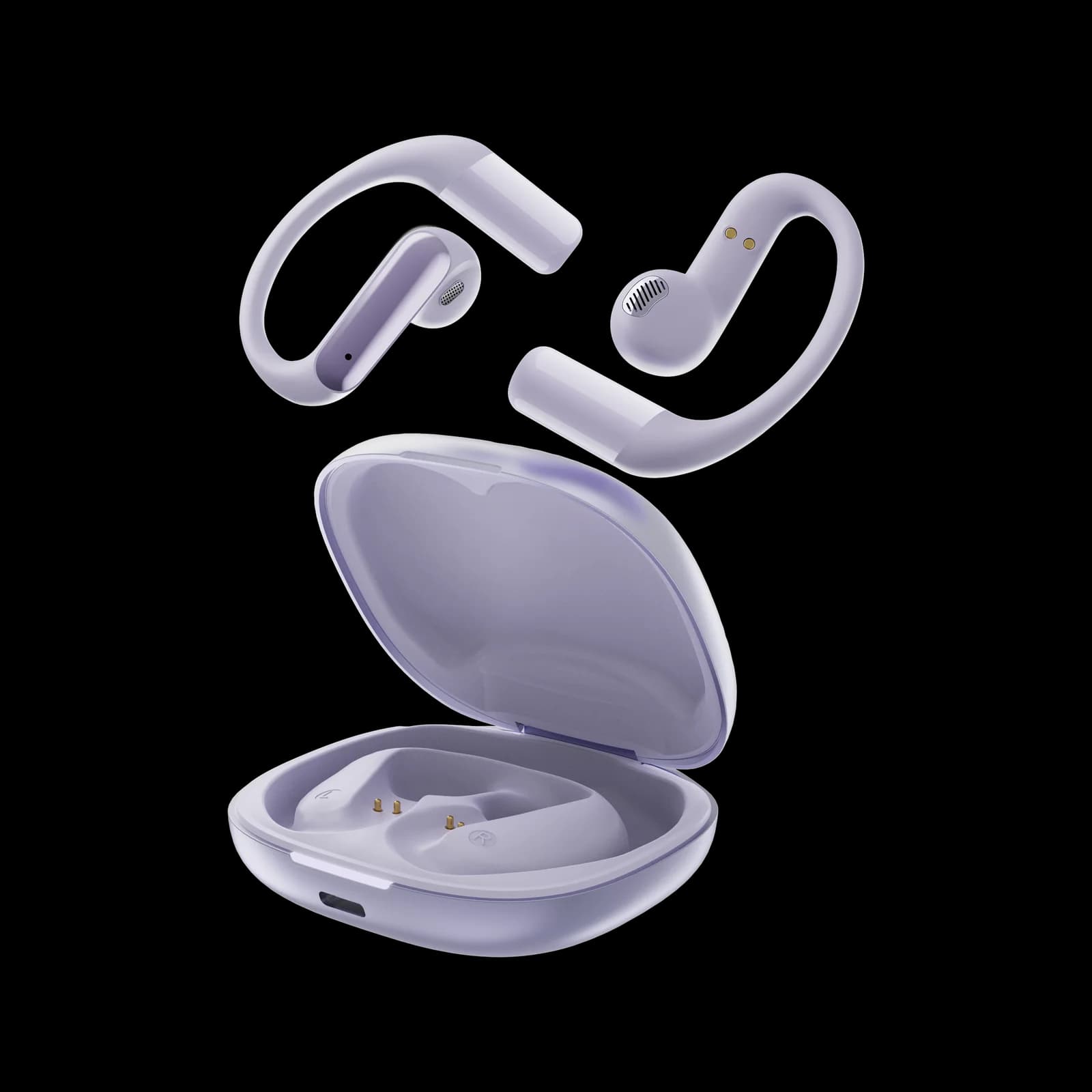
Search either term and you get the same stock photo of a runner on a coastal road. The categories get lumped together because both leave your ear canal open and both let you hear a car behind you. That is where the similarity ends, and the difference shows up in places buyers do not check until after the return window.
Short version: bone conduction vibrates your skull. Open-ear air conduction fires a small speaker at your ear from outside. One bypasses your eardrum, the other uses it normally. Everything below follows from that.
Two routes to the same inner ear
Bone conduction pads sit on the cheekbone in front of the ear and send vibration through bone to the cochlea. Open-ear buds — clip, hook, or the odd donut shape — put a miniature driver near the canal and let air carry the sound in. Same destination, different door.
SoundGuys describes what that feels like from the user's side: with bone conduction, "you feel the music as much as you hear it, and at higher volumes, the vibration can turn into a tickle on your face that some people never get used to." That is not a defect. It is the mechanism working as designed.
The same article's verdict on sound is blunt in a way that matters for buying decisions: open earbuds "sound considerably better than bone conduction — not as good as sealed earbuds, mind you, since you still lose most of the bass without a seal." A dynamic driver pushing air beats a transducer shaking your zygomatic bone, and no amount of tuning closes that gap.
The comparison people actually need
Bone conduction | Open-ear clip / hook | |
|---|---|---|
Path to inner ear | Vibration through bone, bypasses eardrum | Air from a driver aimed at the canal |
Bass | Thinnest of the three formats; low frequencies travel badly through bone | Light versus a sealed in-ear, but fuller than bone conduction |
Comfort over two hours | Clamping pressure on the cheekbone adds up | Load sits on the ear rim; no facial pressure |
Glasses, sunglasses, helmet straps | Competes for space behind the ear and across the temple | Clip clears most frames; a hook can fight a temple arm |
Sound leaking to people nearby | Leaks, especially at high volume | Leaks too; louder volume equals more leakage |
Sweat and water | The format's strength — sealed electronics, no ear tips | Depends entirely on the IP rating; ours is IPX5 on the W12 |
Who it suits | Swimmers, riders who want zero canal contact, some hearing-aid users | Music listeners who want awareness without facial vibration |
Two rows are worth expanding, because they are where buyers get surprised.
Comfort. Bone conduction works by pressing against bone. SoundGuys notes that "after a couple of hours, that pressure adds up." A clip does not press on your face at all, but it does grip your ear rim, and that grip has its own limit — which is why fit matters more than spec on this format. Their line on clip-ons is the one to remember: "If a clip-on doesn't fit your ear, nothing else on the spec sheet matters."
Glasses. SoundGuys puts it plainly: sunglasses and a bone conduction band "cause a similar fight" as a helmet strap does. A clip-on avoids the behind-ear real estate entirely, which is why this shape keeps appearing in listings aimed at people who wear frames. If that is your situation, there is a longer piece on fitting earbuds around glasses with the specific checks.
Where the clip format quietly wins
One detail from SoundGuys' testing is easy to miss and explains a lot of real-world experience: clip-on designs put "the driver closer to your ear canal, so you don't have to crank the volume as hard to hear over traffic." Hook-style open buds hang further out, and bone conduction puts nothing near the canal at all.
Lower volume for the same perceived loudness is not a small thing. Hearing damage is a function of level and time — NIOSH puts its recommended limit at 85 dBA over eight hours, halving the allowed time for every 3 dB above that. Any design that gets you to the same intelligibility at a lower setting is doing your ears a favour, whether or not the marketing mentions it.
This is also why the category has grown up. Third-party tracking of Amazon US listings for the phrase "open ear earbuds" counted 49 products in mid-2026, with the top ten averaging roughly 6,700 units a month at an average price around $86. That is an estimate from a sales-analytics vendor, not a manufacturer figure, but it tells you the format is no longer a niche experiment — and that prices have room to fall further.
Where bone conduction is the right answer, and we are not
Our range is air conduction. Every model is a driver in a housing, aimed at the ear. So take the following as the honest boundary of what we can sell you.
Buy bone conduction instead if you swim laps — no air-conduction bud survives that, regardless of IP rating claims. Buy it if you wear in-ear hearing aids, or if you have hearing in one ear only and want stereo from a single-sided device: bypassing the eardrum is the entire point of the technology, and no clip-on replicates it. Buy it if you want zero contact with your ear rim and facial vibration does not bother you.
Buy open-ear air conduction if you want to listen to music rather than podcasts, if you take calls with any regularity, and if the thing on your head is often glasses or a helmet.
For a like-for-like sense of the air-conduction side: the W12 clip is an 11 mm driver on a 30 mAh bud with a 300 mAh case, manufacturer-rated at 4.5–6 hours per charge. If bass is the thing you refuse to lose, the G116 hook carries a 16 mm dual-magnetic driver — the largest in our open-ear range — and that extra cone area is the usual reason a bigger driver holds low frequencies better. We have not measured the two against each other, so treat it as a reason to audition rather than a result.
Buying checks that apply to both formats
Decide what you refuse to lose. Bass, awareness, water, or facial comfort. Pick one. No format wins two of those outright.
Try it with your glasses or helmet on. Not after. The conflict only appears when both objects want the same millimetre of skin.
Check whether the IP rating covers the charging case. It usually does not, and a wet case is how these products die.
Ignore the volume ceiling on the box. Ask what the battery does at 70% volume, because that is where you will actually listen.
Frequently asked questions
Is bone conduction better than open ear earbuds?
For water and for hearing-aid users, yes, decisively. For music and calls, open-ear air conduction generally sounds better, because a driver moving air reproduces low frequencies more faithfully than a vibrating pad on your cheekbone.
Do open ear earbuds hurt after a while?
They can, and the cause is usually the grip rather than the driver. A clip that is too tight presses the ear rim; one that is too loose shifts. Fit is the whole ballgame on this format, which is why return policies matter more than they do for in-ears.
Which is safer for cycling?
Both keep the canal open, so both let traffic reach you. Neither is a substitute for looking. Riding with any audio at high volume cancels the advantage, because the music masks what the open ear was supposed to hear.
Can you wear bone conduction with glasses?
You can, and many people do, but the band and the temple arm compete for the same strip behind the ear. A clip-on sidesteps that conflict because nothing wraps behind the ear.
Why is bass weak on both?
Bass needs a sealed volume of air to build pressure. Neither format seals the canal, so both lose the bottom end, and bone conduction loses more because low frequencies transmit poorly through bone.
Sources
SoundGuys, "Bone conduction vs open earbuds" (2026) — vibration sensation, clamping pressure over hours, relative sound quality, driver-to-canal distance, glasses and helmet conflicts: https://www.soundguys.com/bone-conduction-vs-open-earbuds-160735
SoundGuys, "I've tested the top clip-on earbuds of 2026" — clip-on trade-offs on bass and isolation, fit as the deciding variable: https://www.soundguys.com/best-clip-on-earbuds-2026-155602
CDC/NIOSH, "Noise-Induced Hearing Loss" — 85 dBA over eight hours, 3 dB exchange rate: https://www.cdc.gov/niosh/noise/about/noise.html
Asinsight, "Best Selling Open Ear Earbuds" (US, July 2026) — 49 tracked listings, top-ten average sales and price: https://www.asinsight.com/report/US/open-ear-earbuds
Editorial publication note: W12 figures (4.5–6 hours per charge, IPX5) and the 16 mm driver on the G116 are manufacturer-rated specifications, not measurements. The Amazon category numbers are a third-party vendor estimate and should be read as an order of magnitude. We publish no frequency-response or leakage measurements for any model, so comparisons of bass between our own products are reasoned, not measured.