
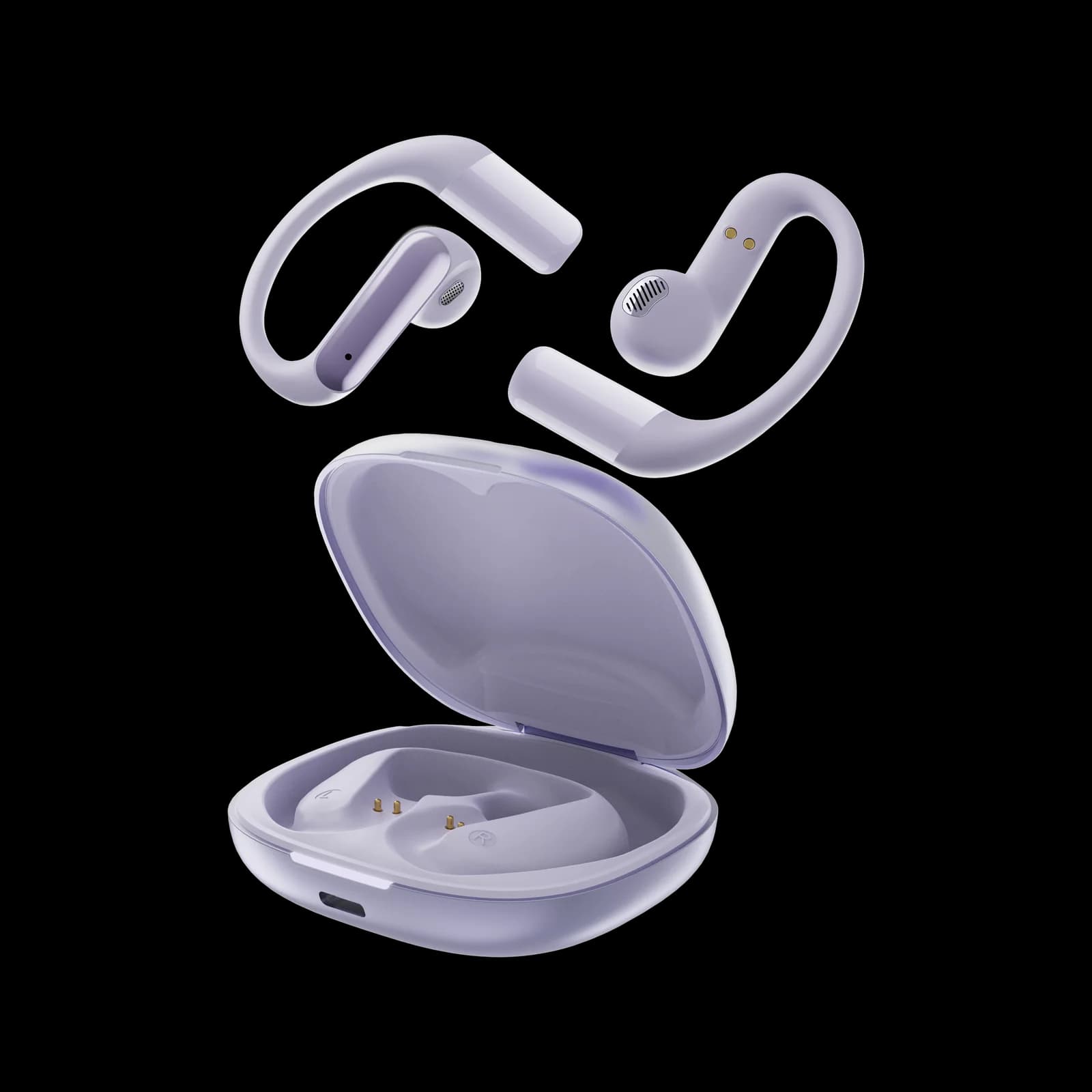
By four in the afternoon there is a tender spot behind your right ear. You assume it is the earbud. Sometimes it is — but often it is the temple arm of your glasses, pushed outward by the earbud, pressing the same patch of skin from two directions.
That is the actual problem for anyone who wears frames daily. Not sound quality, not battery. Geometry.
One strip of skin, four things competing for it
Behind your ear there is a groove between the skull and the ear itself. Your temple arm runs through it. So does a mask loop. So does a helmet strap when you ride. An ear hook wants that groove too, and an over-ear band claims the whole area.
An earbud that sits in the canal with a short stem barely touches it. An open-ear clip sits on the ear rim, in front of the groove rather than in it. An ear hook runs straight down the groove. That difference in footprint is most of the answer.
SoundGuys noticed the same collision from a different angle, comparing bone conduction bands to glasses: sunglasses and a band "cause a similar fight" as a helmet strap does. The band and the arm want the same real estate. A clip avoids it because it never wraps behind the ear.
One aggregator review of the 2026 open-ear market makes a stronger version of the claim — that the clip-on helix design "genuinely resolves the glasses-conflict problem that plagues hook-style earbuds." That is a reviewer's judgement, not a measurement. We would soften it to "resolves most of it", because a thick acetate frame and a tight clip can still find each other.
Which shapes win and which lose
Shape | Contact with the temple arm | Typical result | Watch out for |
|---|---|---|---|
In-ear, no stem | None to minimal | Best-case for glasses | Canal pressure after a few hours |
In-ear with stem | Stem rests beside the arm | Usually fine | Stem pushes the frame slightly outward |
Open-ear clip | Sits on the ear rim, ahead of the arm | Clears most frames | Tight clip plus thick arm equals pressure |
Open-ear ear hook | Runs down the same groove as the arm | Most conflict | Hook pushes glasses forward; lens angle shifts |
Bone conduction band | Claims the groove and the temple | Worst conflict | Band and arm fight continuously |
The lens-angle point is the one nobody mentions. When a hook pushes your frame outward, the lenses tilt, and by evening you have a headache you will blame on the screen. It is worth testing in a mirror: put the buds in, put your glasses on, and look at whether the arms are still parallel to your head.
What to check before buying, in order
Measure your temple arm thickness. Thin metal frames are around 1–2 mm at the tip; thick acetate can be 4 mm or more. The thicker the arm, the more the earbud has to give.
Look at where the clip closes. A clip grips the ear rim, not the arm, so what matters is whether the housing is thin enough to sit against your ear without levering the frame.
Wear both for twenty minutes, not two. Pressure injuries are cumulative and painless at first. This is the same advice we give for side sleeping with earbuds in, and for the same reason.
Try your prescription pair, not your sunglasses. Sunglasses are often thinner and lighter than the frames you wear eight hours a day.
Check the return window before you commit. Fit is the one thing no spec sheet can settle.
For a reference point from our own range: the W12 clip puts an 11 mm driver on the ear rim with nothing behind the ear, which is the shape that clears frames most reliably in our experience. The KT01 uses the same 11 mm platform with a 300 mAh case if you want a second clip option. We have not measured temple-arm clearance on either, and we are not going to pretend a millimetre figure exists — ask for a sample if your frames are unusually thick.
If you would rather keep in-ears
Plenty of glasses wearers stay with in-ears and simply accept the trade. It works, with two adjustments.
Use a shallow fit rather than a deep one. The deeper the tip goes, the more the housing sits proud of your ear and the more it interferes with the arm. And check whether your frames sit close to your head at the temple: if they do, a stem-style bud will push them out, so a stemless body is the better choice.
If you want the sealed fit for noise reasons — sleeping, an open-plan office — our in-ear sleep model is the V18, a 10 mm sealed in-ear with a 200 mAh case and no noise-cancelling claim attached. Sealing the canal is what cuts steady room noise, and a sealed tip is also the shape least likely to touch your glasses.
The honest limitation
A clip is better for glasses than a hook or a band. It is not invisible to them. Thick frames, a tight clip, and a long day will still produce a sore spot, and no design in this category fixes that — the fix is a thinner clip, a lighter frame, or taking the buds out for an hour.
We also have a commercial interest here, so weigh our advice accordingly. The one thing we will not do is claim a clearance number we never measured.
If the pressure is coming from the earbud's grip rather than the frame — a clip that pinches the ear rim — that is a slightly different problem, and the fit discussion in our small-ears piece covers what a good grip should feel like.
Frequently asked questions
What earbuds are best for people who wear glasses?
Any shape that does not wrap behind your ear is a reasonable start. Clip-on open-ear buds sit on the ear rim and leave the groove behind the ear free, which is where temple arms and mask loops already live.
Can you wear ear hooks with glasses?
You can, but expect the hook and the arm to push against each other. The practical symptoms are a sore spot behind the ear and frames that gradually tilt outward during the day.
Do clip-on earbuds press on glasses?
They press on your ear rim, not on the frame, which is why they usually clear. A very thick acetate arm plus a tight clip is the case where the two do meet.
Is it better to just use one earbud?
Some people do, and it removes the conflict on one side entirely. The catch is that you lose stereo and, on most true wireless pairs, the remaining bud carries the whole link — worth knowing before you make it a habit.
Will glasses damage the earbuds?
No. The mechanical load runs the other way: the earbud pushes your frame outward, and the frame's spring pushes back on the earbud's housing. The thing that suffers is the skin behind your ear.
Sources
SoundGuys, "Bone conduction vs open earbuds" (2026) — sunglasses and bands competing for the same space behind the ear: https://www.soundguys.com/bone-conduction-vs-open-earbuds-160735
SoundGuys, "I've tested the top clip-on earbuds of 2026" — clip grip, fit variability and why fit outranks every other spec: https://www.soundguys.com/best-clip-on-earbuds-2026-155602
CompareWize, "Best Open-Ear and Bone-Conduction Headphones in 2026" — reviewer claim that the helix clip design resolves the glasses conflict that affects hooks: https://comparewize.com/audio/best-open-ear-bone-conduction-headphones-2026
Editorial publication note: No model-specific clearance, pressure or weight figures are published here because none have been measured for this purpose. W12 driver and case figures are manufacturer-rated; the V18 is described as a sealed in-ear with passive isolation only, with no noise-cancelling claim. The temple-arm thickness ranges are general frame dimensions, not measurements of a specific product.