
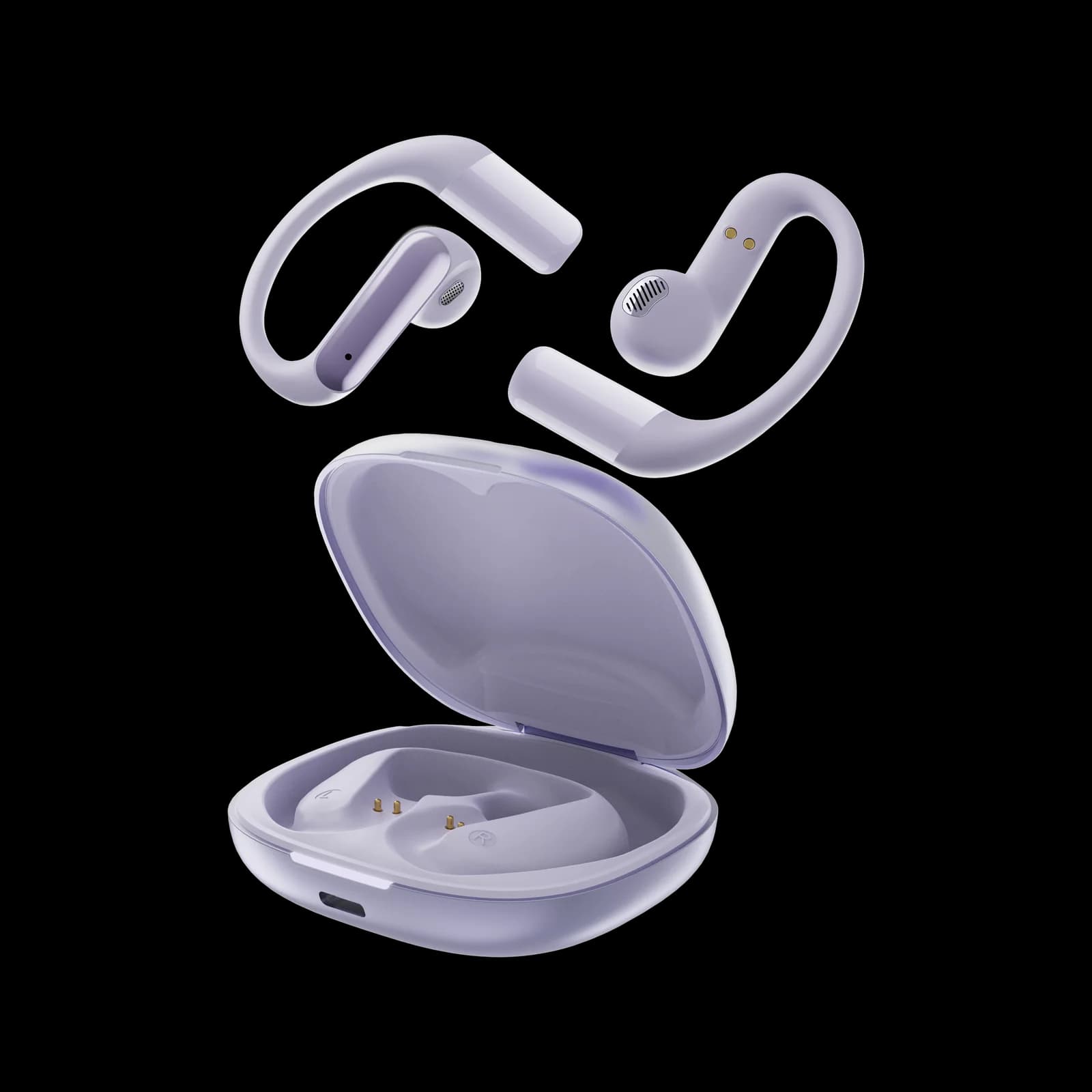
The first ten seconds are the disappointment. You clip them on, play a track you know well, and the kick drum is there but thin, the bassline is a suggestion rather than a presence. Everything from the low mids upward arrives cleanly, which somehow makes the missing bottom end more obvious.
This is the single loudest complaint in open-ear reviews, and it is not a quality-control problem. It is the format.
Bass needs trapped air
A sealed in-ear traps a small volume of air between the driver and your eardrum. Push the driver, pressurise that volume, and you get low-frequency output. It is why a cheap sealed bud can produce a kick you can feel.
Open the canal and that pressure escapes. The driver now pushes air into a room, competing with everything else in it. Low frequencies need to move far more air than high ones to reach the same loudness, and a small driver radiating into open space runs out of displacement long before it runs out of treble.
SoundGuys states the consequence without softening it: on clip-on earbuds "there's no noise canceling and almost nothing blocking outside sound, and bass is much quieter than it is on earbuds or headphones that seal your ear. Equalizer settings help a little, but they won't fully fix it."
That last clause is the useful one. EQ can lift the low end, but a driver that cannot pressurise the air in front of it will distort before it gets loud, and boosting 60 Hz by 6 dB on an open bud mostly buys you a wobbling midrange.
Three formats, ranked honestly
Sealed in-ear | Open-ear clip / hook | Bone conduction | |
|---|---|---|---|
Bass relative to the others | Strongest — the seal is the mechanism | Moderate at best; audible but not felt | Weakest; low frequencies travel badly through bone |
Isolation | High, and that is the trade | Almost none | Almost none |
Awareness of the room | Low | High | High |
Typical failure in loud places | You cannot hear a warning | Ambient noise competes with the music | Same, worse |
Best for | Music, flights, noisy commutes | Calls, awareness, all-day wear | Water, hearing-aid users |
If you want one sentence: a sealed in-ear buys bass with awareness, and an open bud buys awareness with bass. Neither is better. They are different purchases.
What actually helps, and what does not
Driver size helps, up to a point. More cone area moves more air, which is the usual reason a larger driver holds low frequencies better in an open design. Our G116 hook carries a 16 mm dual-magnetic driver, the largest in our open-ear range, against 11 mm in the W12 clip. We have not measured the two side by side, so we will not tell you how many decibels of difference that buys — only that it is the first thing to audition if bass is your complaint.
Driver position helps more than people realise. SoundGuys notes that clip-style buds put the driver "closer to your ear canal, so you don't have to crank the volume as hard to hear over traffic." Closer means less of the output is lost to the room, and less volume needed for the same perceived loudness. It is also better for your ears: NIOSH sets its recommended exposure limit at 85 dBA averaged over eight hours, halving the allowed time for each 3 dB above that.
Fit helps in a way that is easy to miss. If the housing sits loose, the driver is aiming past your ear rather than at it, and everything sounds thin — including the treble, which people blame on the source. A clip that holds the housing steady is worth more than any EQ preset.
EQ helps a little, and marketing helps less. "Deep bass" on an open-ear listing means "deep bass for an open-ear product". Treat every bass adjective in this category as relative. The absence of a frequency-response graph in a listing is the honest signal.
Turning the volume up does not help. It raises the whole spectrum, masks the room you bought open buds to hear, and moves you closer to a hearing-safety problem. If a track needs 90% volume to feel right on an open bud, the bud is the wrong format for that track.
When you should buy in-ear instead
Be honest with yourself about the use case.
If you listen to bass-heavy music as the main event — hip-hop, electronic, anything built on sub-bass — an open bud will frustrate you forever, and no amount of research fixes it. Buy a sealed in-ear. If you want noise handled as well, our V8 is the in-ear model the manufacturer rates for ANC and ENC dual noise reduction, with the largest case in the range at 380 mAh.
If you want awareness during the day, calls that do not feel like you are cut off from the room, and a bud you forget you are wearing, the open format wins and the bass is the price. That is not a compromise we can talk you out of, and any brand claiming otherwise is selling a different product than it describes.
What we have measured, and what we have not
We keep this separation tight, because it is the difference between a useful page and a liability.
Measured on our own W12, one sample, one tester, recorded 6 November 2026: about 5 hours of continuous playback at 50% volume, roughly 4 hours of continuous call, zero adjustments across 60 minutes of strength work plus a 30-minute treadmill run at console speed 7 on a 4% incline, and a microphone pickup reading of about 45 dB from a 70 dB speech level on an iPhone 15 Pro with noise reduction enabled. One unit, one ear shape. A data point, not a specification.
Not measured: frequency response, bass extension, or leakage. We have no calibrated acoustic measurement for any model, so every sentence above about bass is either cited to SoundGuys or framed as reasoning. If a competitor publishes a graph and we do not, that is a fair thing to hold against us.
Frequently asked questions
Do open ear earbuds have any bass at all?
Yes, and it is clearly audible — vocals, bass guitar and kick drums all come through. What is missing is the sub-bass pressure a sealed design produces, and the difference is obvious on bass-heavy tracks played back to back.
Can EQ fix the bass on open ear earbuds?
Partly. A modest low-shelf boost adds warmth, but a driver radiating into open air runs out of excursion, so heavy boosts distort instead of deepening. SoundGuys' assessment is that EQ helps a little and does not fully fix it.
Are bigger drivers better for open ear bass?
Generally yes, because more cone area moves more air. It is not a linear rule, and we have not measured our own 16 mm driver against our 11 mm one, so treat driver size as a shortlist filter rather than a verdict.
Why do open ear earbuds sound louder in a quiet room?
Because there is no seal to contain the output or block the room, so the balance between your audio and the environment changes with the environment. In a quiet room they sound fuller; on a busy street the street wins.
Should I buy open ear earbuds for the gym?
Only if hearing the room matters more to you than bass does — which for many gym users it does not. Our guide to choosing by workout type walks through that decision with the noise levels of a typical gym floor in mind.
Sources
SoundGuys, "I've tested the top clip-on earbuds of 2026" — the bass and isolation trade on clip-ons, the limits of EQ, and the driver's proximity to the canal: https://www.soundguys.com/best-clip-on-earbuds-2026-155602
SoundGuys, "Bone conduction vs open earbuds" (2026) — why air-conduction open buds sound better than bone conduction yet still lose most of the bass: https://www.soundguys.com/bone-conduction-vs-open-earbuds-160735
CDC/NIOSH, "Noise-Induced Hearing Loss" — 85 dBA recommended exposure limit over eight hours, 3 dB exchange rate: https://www.cdc.gov/niosh/noise/about/noise.html
Editorial publication note: Driver sizes (11 mm on the W12, 16 mm on the G116), the 4.5–6 hour playback rating and the IPX5 rating are manufacturer specifications. The playback, call, gym and microphone figures come from a single recorded session on one W12 sample on 6 November 2026 and describe that unit only. No acoustic measurements — frequency response, bass extension, leakage — exist for any model, and none are implied here. The V8 noise-reduction claim is manufacturer-rated, not measured.