
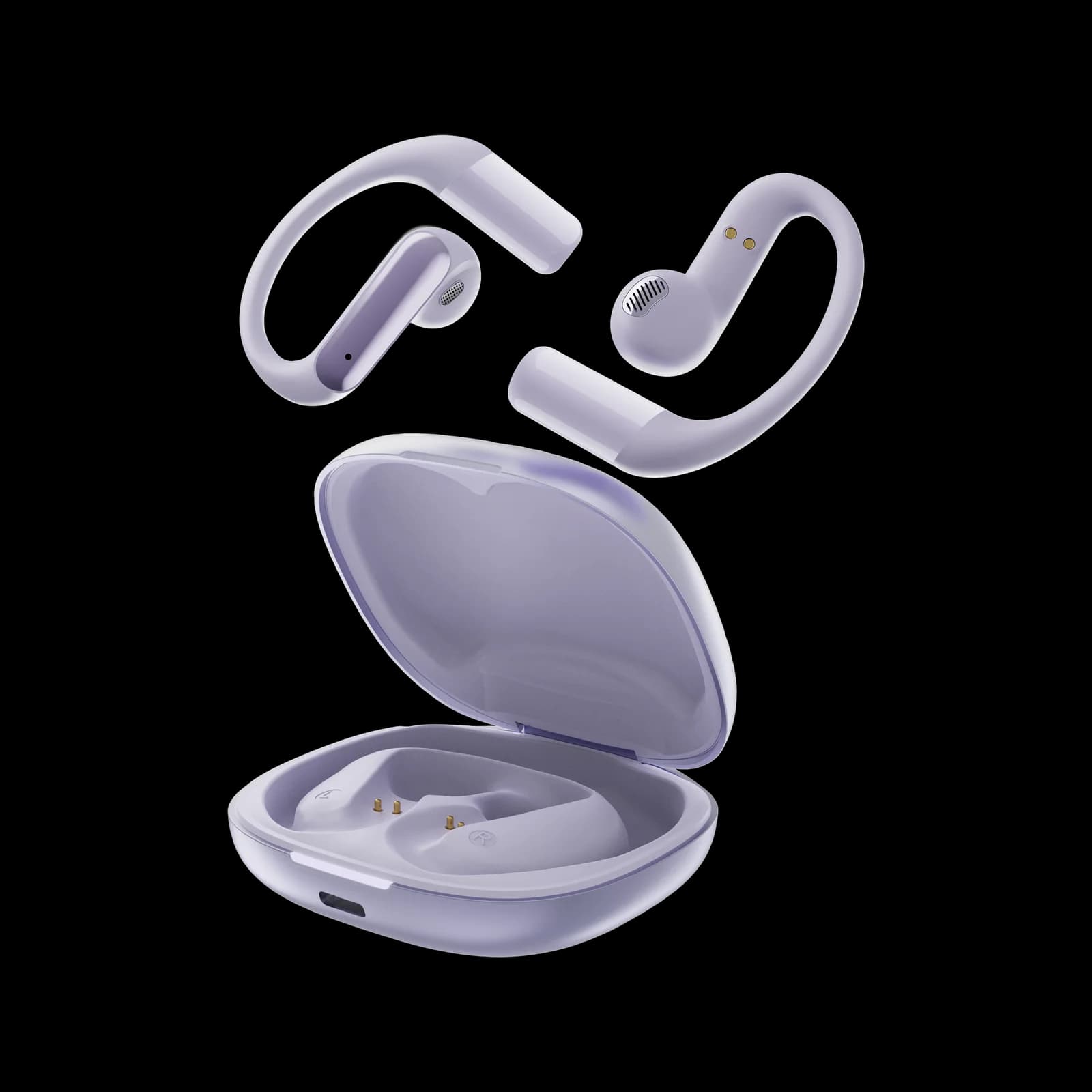
Snoring is the most common reason people search for sleep earbuds, and the most common reason they send them back. No consumer earbud erases a snore. What changes from one design to the next is how much of it you can remove, and that comes down to two variables: whether the earbud seals your ear canal, and whether the volume is set to match the noise level in the room.
Get either one wrong and you spend the night turning the volume up — which is the point where a comfort purchase turns into a hearing-risk habit.
Why snoring is hard to block
Snoring is low-frequency sound. Most of its energy sits below roughly 200 Hz — the same band as traffic rumble, air-conditioning hum and ventilation noise.
Low frequencies are difficult for two reasons. They pass through materials that stop higher sounds, and they diffract around obstacles rather than being shadowed by them. A thin silicone seal blocks a surprising amount above 2 kHz and comparatively little below 200 Hz. SoundGuys measured exactly that pattern on the Ozlo Sleepbuds 2: strong passive isolation in the higher frequencies, only about 5–10 dB below 200 Hz.
Five to ten decibels is audible — roughly the difference between a loud snore and a moderately loud one. It is not silence. That figure is also why the seal matters more than the marketing: 5 dB of attenuation only happens when the tip fits properly, and a loose tip delivers close to nothing.
Three mechanisms, three different results
Mechanism | What it does to snoring | Where you find it | Limitation to know |
|---|---|---|---|
Passive seal | Removes some low-frequency energy, most at higher pitches | Foam earplugs, sealed in-ear sleep buds (our V18) | 5–10 dB in the snoring band at best; fit decides everything |
Active noise cancellation | Electronically cancels steady low-frequency sound, strongest around 20–200 Hz | ANC in-ear buds (our V8, V20, V16 Pro), over-ear headphones | Works on steady sound, not on irregular or sharp noises |
Masking audio | Adds a competing sound so the brain stops tracking the snore | Most budget "sleep" buds, apps, fans | Does not reduce sound pressure — it competes with it |
ANC is the only mechanism aimed squarely at the band where snoring lives, which is why sleep buds that carry it cost more than masking-only products. Masking does not lower the noise; it raises the floor beneath it, and that floor is your volume setting.
There is a fourth option nobody markets because it is unglamorous: treat the snoring. Positional therapy, a dental appliance, a sleep study. Earbuds are a workaround for a medical issue, and they work better once the source has been looked at.
Matching volume to the noise instead of guessing
Here is the arithmetic most buyers skip. To mask a sound, the audio reaching your ear has to sit roughly 5–10 dB above it. The required volume is therefore set by the snore, not by preference.
Snore level at your pillow | What it sounds like | Rough volume needed (open-ear bud) | Practical read |
|---|---|---|---|
40–50 dB | Light, rhythmic, audible only in a quiet room | 50–60% | Comfortable for a full night |
50–60 dB | Normal snoring, audible through a closed door | 65–80% | Workable, but you are listening loudly all night |
60–70 dB | Loud snoring, audible from the next room | 85%+ | Exposure limits start to matter if sustained |
75 dB and above | Very loud, or gasping with pauses | Cannot be safely masked | Address the snoring, not the earbud |
Two reference points explain why the bottom two rows are not solved by pressing the volume button again. WHO/ITU guidance for personal audio puts the adult limit at about 80 dB for 40 hours a week; occupational limits sit at 85 dBA over an eight-hour shift. Sleep is eight hours, and the snore does not pause halfway through.
So the rule worth keeping: raise the volume to what the noise requires, and if that level feels loud or your ears ring in the morning, change the earbud rather than the volume. In practice, an open-ear design suits light-to-moderate snoring and comfort-first listening; a sealed in-ear becomes the better tool once the snore sits in the 60 dB range or above.
One control costs nothing: cap the output. iOS has Headphone Safety with a volume limit; Android has equivalent absolute-volume limits in developer settings or the manufacturer's audio app. Set the ceiling once, then use a sleep timer so audio stops an hour after you fall asleep instead of running until morning.
How the formats compare for this job
Open-ear clip designs, our W12 included, do not seal the canal — that is the entire point of the format: no insertion pressure, and you keep hearing the room, a child, an alarm. The trade-off at night is that the snore reaches you at nearly full level, so you compensate with volume. For a light snorer, or a partner who only snores occasionally, that is a workable arrangement, and it is why a clip design stays popular with side sleepers who want a podcast rather than a sealed ear.
When the noise itself is the problem, the fit has to change:
V18 is our in-ear sleep model. The sealed tip handles attenuation passively — no electronics, no hiss, nothing to recharge mid-night. Its limitation is the one every sealed bud shares: attenuation depends on the tip seating properly, and a sealed canal feels very different from an open ear.
V8, V20 and V16 Pro are in-ear models with ANC and ENC dual noise reduction — ANC against the steady low-frequency component of snoring, ENC for voice clarity on calls during the day. These are manufacturer-rated specifications and we label them as such; we do not publish per-band attenuation numbers for our own models, and you should ask that question of any brand quoting a blocking figure.
Which one fits depends on how you sleep rather than on the spec sheet. Back sleepers tolerate a sealed in-ear far better than side sleepers, who press the housing into a pillow for hours. If you are a side sleeper and want the noise gone, the sealed route usually works only with a flush, shallow-fitting tip — otherwise the comfort problem you were escaping comes back.
If you are buying sleep buds specifically for snoring
Four things to check before paying:
Does the listing say ANC, or only "noise masking"? Masking lifts the floor under the noise. If the copy says "noise masking" and never "noise cancelling," believe it.
Is attenuation published per frequency band? A brand that publishes dB per band is telling you something checkable. "Blocks snoring" is not a specification.
Does it play audio without a phone? On-board sound libraries matter at 2 a.m. — and matter more if you have capped the volume and want the audio to stay low.
What is the per-charge runtime? Audio has to last the night. Compare the bud-only figure, not the total with the case — the arithmetic catches most buyers out.
For realistic expectations: SoundGuys' 2026 testing has the Soundcore Sleep A30 Special rated 8–10 hours per night, while the previous generation measured 7 hours 33 minutes in their test — just short of a full night. That is what "all night" looks like in practice, even at the expensive end of the category.
Where earplugs still win
Foam or silicone earplugs deliver the highest attenuation per dollar of anything on this page, and they never run out of battery. The trade-offs are real: no audio, a fully sealed feeling, and hygiene requirements. Many people land on a hybrid — earplugs on the nights the snoring is bad, an earbud when they want something to fall asleep to.
For side sleepers, earplug comfort depends on how far the plug protrudes; flush-fitting matters more than the NRR printed on the box. The same holds for every sealed in-ear discussed above.
Frequently asked questions
Do sleep earbuds block snoring?
They reduce it rather than block it. Sealed in-ear designs remove some low-frequency energy passively; sealed designs with ANC remove more. Open-ear and headband designs barely attenuate it, so they need a higher volume to compete — a masking strategy, not a blocking one.
How loud should I set sleep earbuds if my partner snores?
Loud enough that the snore stops pulling your attention, and no louder. As a working rule: light snoring needs roughly half volume on an open-ear bud, normal snoring 65–80%, and loud snoring will demand a level that is not safe to sustain for eight hours — which is the signal to move to a sealed in-ear with ANC rather than pushing the volume higher.
What should I look for in sleep earbuds for snoring?
A seal that fits your canal, ANC if the snoring is steady and loud rather than occasional, a per-charge runtime that covers your night, and a published volume limit you can set so the masking level stays safe. What you should not look for is an attenuation promise without a number attached to it.
Is ANC effective against snoring?
It is the most effective electronic option, because snoring energy concentrates in the 20–200 Hz band that ANC targets. It handles steady, continuous snoring well; irregular or sharp sounds — gasps, sudden pitch changes — pass through.
Can I wear earplugs and earbuds at the same time?
Not in the same ear; the plug occupies the canal. The workable combination is earplugs for attenuation plus a headband or bedside speaker if you want audio.
Are sleep earbuds safe if I need to hear an alarm?
A sealed, masking bud makes alarms less reliable. If hearing an alarm or a child matters, use an open-ear design at a low volume, and keep a vibrating alarm as backup.
Sources
SoundGuys, *The best headphones for sleeping in 2026* (ANC band 20–200 Hz; measured runtimes): https://www.soundguys.com/best-headphones-for-sleeping-2-164435/
SoundGuys, *Ozlo Sleepbuds 2 review* (passive isolation above 2 kHz vs 5–10 dB below 200 Hz): https://www.soundguys.com/ozlo-sleepbuds-2-review-161143
WHO/ITU, *Safe listening devices and systems* (80 dB / 40 hours per week adult reference): https://www.who.int/publications/i/item/9789241515276
Editorial publication note: Third-party measurements are attributed to SoundGuys and reflect their lab conditions, not ours. Model claims (V8, V20, V16 Pro ANC + ENC; V18 sealed in-ear fit) are manufacturer-rated wording from the current catalogue, checked against the live product record on November 12, 2026 — no attenuation figure in dB should be attached to our own models without a measured test. Snore-level dB bands are approximate working ranges, not measurements of a specific bedroom.