
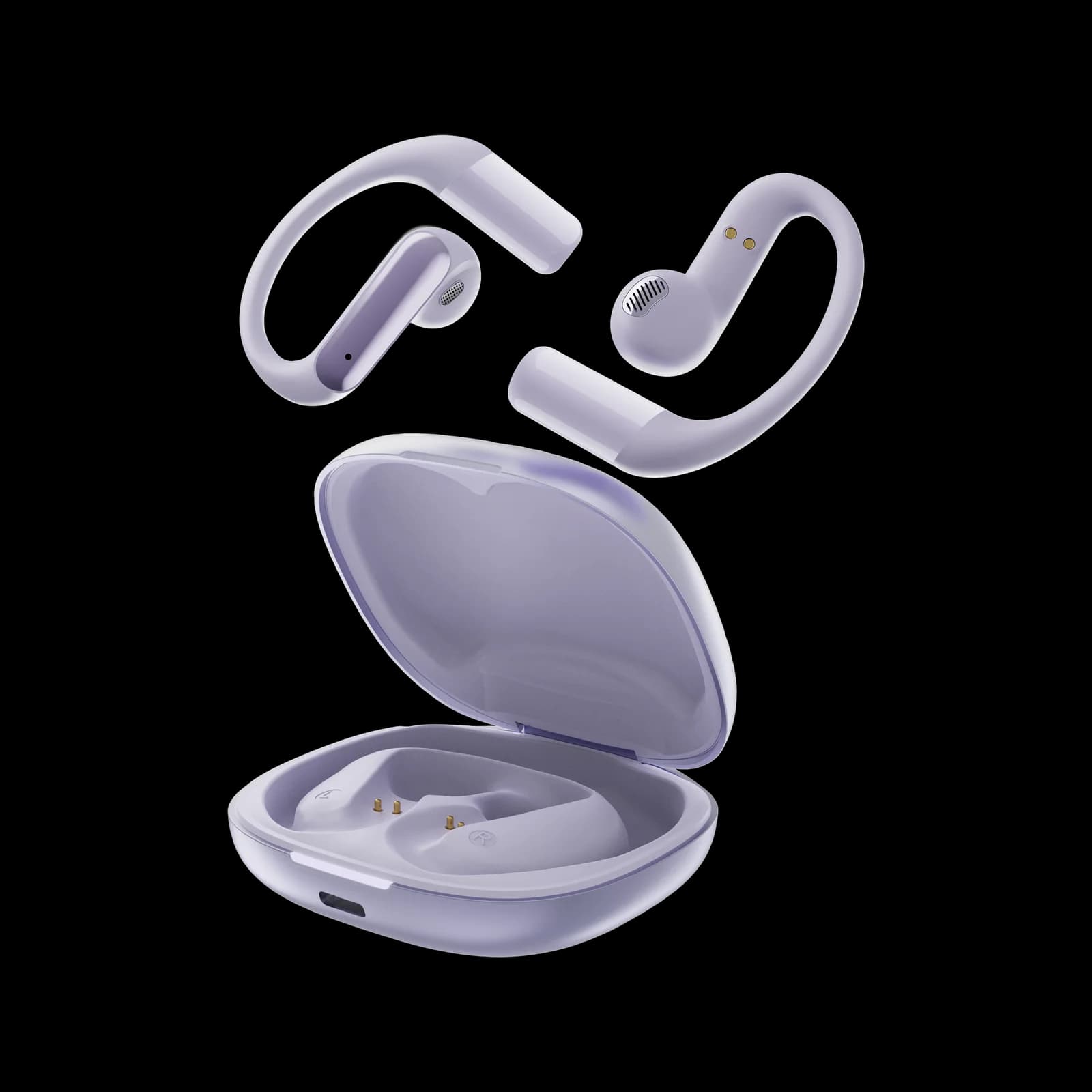
Two listings. One says 380 mAh, the other 300. The instinct is to pick the bigger number and close the tab.
That number describes a reservoir, not a delivery. The bud holds one cell, the case holds a bigger one, and every transfer between them costs something. Earbuds charging efficiency is the name for that cost, and almost nobody prints it. What gets printed instead is capacity, which is the easy half of the story.
What does mAh actually measure?
Milliamp-hours are charge. Watt-hours are energy, and energy is the thing you're really buying. Multiply charge by voltage and the two line up; skip the voltage and a capacity figure means nothing across brands.
Our own spec sheets list a 3.7 V nominal cell, so a 300 mAh case and a 380 mAh case from our range are quoted in the same currency. Cross-brand, that's often not true, and a listing showing mAh with no voltage has told you half a number and let you assume the rest.
The transfer loss is the part that gets skipped. According to Battery University's published measurements, lithium-ion coulombic efficiency sits above 99 percent at moderate current and cool temperature, with energy efficiency around 99 percent at a very slow 0.05C charge, about 97 percent at 0.5C, and lower again at 1C (BU-808c). Read that as a curve, not a constant: slow charging loses almost nothing, fast charging loses more.
Those figures describe the cell. A case topping up a 30 mAh bud is not the whole product. Between the case and the bud sit a boost converter, a charging IC and a small amount of heat, and none of that appears in a coulombic efficiency number. We have no end-to-end measurement of that chain for any of our models. So we won't quote a percentage for it, and you should raise an eyebrow at any brand that does without naming the method.
Why a bigger case doesn't buy a longer night
Two capacities, two jobs. The bud's cell sets how long one session runs. The case sets how many sessions you get before you need a wall socket. Buyers routinely merge them into one expectation, then feel cheated when the bigger case doesn't buy a longer session.
Figure on the box | What it measures | What it can't tell you |
|---|---|---|
Bud capacity (mAh) | charge in one earbud's cell | playback at your volume |
Case capacity (mAh) | reserve carried in the case | how many top-ups you'll actually get |
Playback hours | a rated session length | anything about charging |
"10 min = 2 hours" | a slice of the fast-charge curve | the time to a full charge |
Put our own numbers against that, straight from the spec sheet: the W12 clip-on carries a 30 mAh bud and a 300 mAh case; the V8 in-ear 30 and 380; the V18 sleep model 30 and 200. All three buds hold the same capacity, so the case is where the differences live.
Playback claims get audited elsewhere — how battery life figures are calculated covers the discharge side, including why a rated hour is not an hour at your volume. This article stays on the charging side, because the two get mixed up constantly and the arithmetic only works in one direction.
The arithmetic that overstates your top-ups
Three hundred divided by thirty looks like ten full charges. Nobody gets ten.
Three things eat the difference. The transfer isn't lossless. The last stretch of any lithium-ion charge is slow, because the charger switches from constant current to constant voltage and waits for the current to taper — and according to Battery University a high-current charge fills a cell to roughly 70 percent quickly, while the saturation stage takes considerably longer (BU-409). And a case sitting in a bag for a month loses charge on its own.
We haven't measured a top-up count end to end on any model, so we won't print one. If a listing says "charges your buds 6 times", the useful follow-up is whether that was measured from empty each time, at what temperature, and with the buds idle or playing.
What "10 minutes for 2 hours" is really promising
It's a statement about the first part of the curve, not the whole of it. High current gets a cell up to around 70 percent quickly, and according to the same source, cheap chargers that skip the saturation stage report ready at about 85 percent. That's a real and useful behaviour. It just isn't the same claim as "charges in ten minutes".
The conditions matter more than the number. Starting state, ambient temperature, the charger's current capability and whether the buds were drained all move the result. A fast-charge figure quoted without those is a marketing sentence wearing a specification's clothes.
Why you can't work backwards from playback time
This is the error I see most often in buyer specs: five hours of playback, therefore the bud must take about an hour to charge. There's no such ratio. Playback is a slow discharge across a known load; charging is a current-limited process with a taper at the end, and the taper often takes longer than the bulk stage.
We have one first-hand data point worth stating precisely: about 5 hours of continuous playback at 50 percent volume on a single W12, one unit, one session. That says something about discharge. It says nothing about charge time, and we haven't run a charge curve, so we're not going to manufacture the other half of the comparison.
Four checks before you compare two listings
Ask for watt-hours, or for voltage alongside the mAh. Without one of the two, capacity comparisons are guesswork.
Ask whether the case figure is usable or nominal. Nominal is what the cell holds; usable is what reaches the buds.
Ask for charge time from empty with the included cable. Not "fast charge", not a percentage in ten minutes.
Ask what the top-up count was measured against. Idle buds, playing buds and a cold room give three different answers.
Frequently asked questions
Does a bigger charging case mean longer battery life?
No. It means more top-ups between wall sockets. The session length is set by the bud's cell, the driver and your volume, and all three models in our own range carry the same 30 mAh bud cell despite cases from 200 to 380 mAh.
What does mAh mean on an earbud listing?
It's charge capacity — how much current the cell can deliver over an hour at its rated voltage. It becomes energy, and therefore comparable, only once you multiply by that voltage. Two packs at different voltages with the same mAh hold different amounts of energy.
Why does my case charge the buds fewer times than the maths suggests?
Because the maths assumes a lossless transfer and a full charge every cycle. Real transfers lose a little energy, the final part of each charge tapers slowly, and the case discharges itself while it waits in a drawer. A count quoted without a method is usually the ideal case.
Do fast-charge claims shorten battery life?
Sustained high-rate charging is harder on a cell than a slow charge, which is why efficiency drops at higher rates in the source above. A short boost now and then is not the same as living on a fast charger, and no honest answer exists without knowing the cell and the charger.
Can I use my phone charger on earbuds?
Usually, because the bud's charging circuit draws what it needs rather than what the charger can supply. The failure mode to avoid is a cheap unregulated supply and a cable with damaged contacts, not a charger with a higher current rating than the case needs.
Sources
Battery University, BU-808c: Coulombic and Energy Efficiency — coulombic efficiency above 99 percent at moderate current; energy efficiency about 99 percent at 0.05C, 97 percent at 0.5C, lower at 1C; ultra-fast charging reduces it.
Battery University, BU-409: Charging Lithium-ion — constant-current then constant-voltage profile; high current fills to roughly 70 percent; charge-and-run chargers report ready near 85 percent.
Our own product specification sheets — 30 mAh bud cells across W12, V8 and V18; case capacities of 300, 380 and 200 mAh; 3.7 V nominal.
Our first-hand W12 log — about 5 hours continuous playback at 50 percent volume, one unit, one session.
Editorial publication note: Capacity figures are manufacturer-rated from our own spec sheets, and the single playback figure is a first-hand measurement on one unit. Efficiency percentages come from Battery University's published measurements at cell level, not from our products. We have not measured an end-to-end case-to-bud efficiency, a charge curve or a top-up count for any model, and no number in this article is derived from playback time. Where a figure would have required a measurement we don't have, it was left out rather than estimated.