
You put the helmet on, and something has to give. Either the pad squashes a bud into your ear, or the strap drags an ear hook off as you pull it down, or — with over-ear headphones — the helmet simply will not go on. Then you get to 100 km/h and the wind noise arrives, and suddenly the music you could hear at the lights is gone.
That sequence is why riders keep asking which earbuds work under a helmet. The answer is mostly about shape and where the pressure lands, not about driver size or Bluetooth version.
The helmet decides the shape, not the spec sheet
A full-face helmet is designed to clamp your skull, with padding that closes over the ears. Most shells leave a shallow recess near the ear, and that recess is where a bud has to live for the next two hours. A stem that hangs down from the ear canal will be folded over by the pad. An ear hook that loops behind the ear sits exactly where the strap passes. A headband — bone conduction or otherwise — has nowhere to go at all.
SoundGuys tested this on a bicycle helmet rather than a motorcycle one and described the same collision: "On the bike, a helmet strap runs right across the same real estate a bone conduction band wants, and I was constantly shoving mine back into place. Open earbuds tuck around the ear and stay put under a strap." A motorcycle strap applies more force than a bicycle one, so the difference gets sharper, not softer.
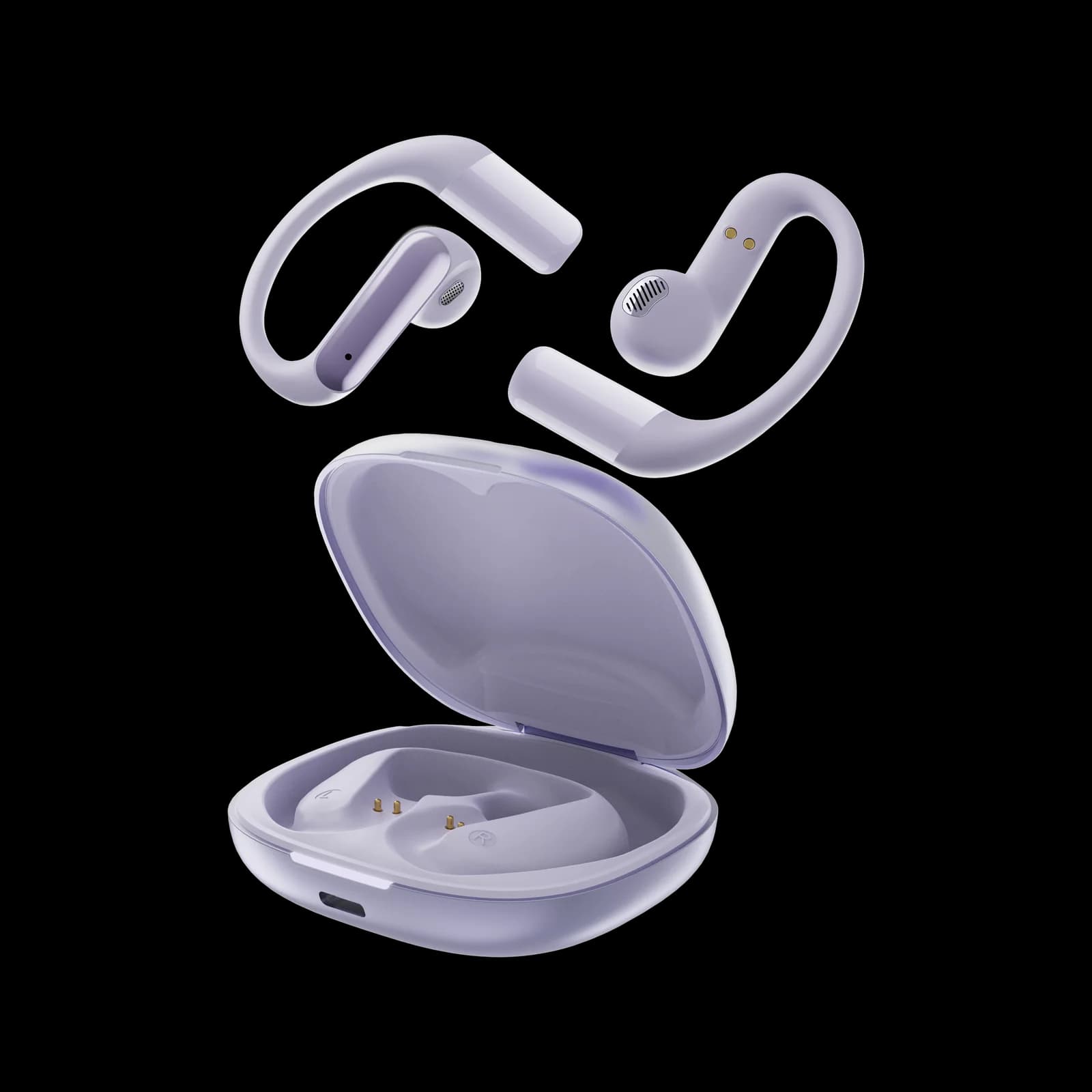
A clip-on open-ear bud avoids the fight because there is nothing behind your ear and nothing inside the canal. The housing sits on the rim of the ear, inside that pad recess, and the strap passes over it instead of pulling it off. That is the structural reason this format keeps coming up in rider forums — not marketing.
Four shapes, one helmet
Format | Under a full-face helmet | Wind noise | Awareness of traffic | Where it fails |
|---|---|---|---|---|
Clip-on open ear | Fits inside the ear recess; strap passes over it | Present, worse at speed | Ear canal stays open | Thick pads can still press the housing |
Ear hook | Usually squeezed by the pad; hook competes with the strap | Similar to clip | Open | Hook gets pushed forward when you pull the helmet on |
In-ear with tip | Seals, so it fights the pad hardest; can be painful on a long ride | Lowest of the four | Almost none — this is the safety problem | Pressure on the canal wall, plus you cannot hear a horn |
Bone conduction band | Does not fit; the band sits where the strap sits | Handles wind better than open ear | Highest | No room under the shell |
Two of those rows are honest losses for us. A sealed in-ear will always beat an open design on wind noise, because it blocks the noise instead of competing with it. If your priority is quiet at 120 km/h on a motorway, buy a sealed in-ear and accept that you will not hear much else. The open format is for riders who want audio and the road at the same time, and who are willing to give up bass and isolation to get it.
Wind, volume, and the number that matters
Here is the part riders skip. Wind noise rises with speed, the music has to rise with it, and nothing in the ear canal protects you from the result. NIOSH sets its recommended exposure limit at 85 dBA averaged over an eight-hour day, and reduces the allowable time for every 3 dBA above that — so 88 dBA halves it, 91 dBA halves it again.
An open-ear bud with the volume pushed up on a motorway is not an eight-hour exposure. It is a short one, repeated every ride, and nobody keeps a record of the total — which is exactly why the limit gets crossed without anyone noticing.
Practical rule we would give a friend: set the volume at a standstill, in a quiet car park, at a level you would use in an office. A sealed bud reaches the same perceived loudness on the road at a lower setting, because it blocks wind instead of competing with it — that is the whole reason riders end up turning the dial. Then leave it alone once you are moving. If you cannot hear the audio at speed at that setting, the honest fix is a sealed in-ear or a quieter helmet, not more volume.
What to check before you ride
Put the helmet on with the buds in, twice. Once slowly, once the way you actually do it when you are late. The second attempt is the one that pulls hooks off.
Check the pad pressure point. Ride for twenty minutes and feel behind your ear rim. A dull ache that appears at twenty minutes becomes a headache at two hours.
Run the visor up at 60 km/h. Wind noise through an open visor is the closest thing to a worst case, and it tells you how much volume headroom you actually have.
Test the mic before you rely on it. Open designs pick up wind, and callers hear it. Our own note on workplace calls covers what a clip mic does and does not fix.
Check the law where you ride. Rules on headphones while riding vary by country and by state, and some places restrict them outright. That is not something a product page can answer for you.
For reference, our W12 clip model is the shape we would point a rider to: the housing loads the ear rim, nothing sits behind the ear, and the manufacturer rates it at 4.5–6 hours of playback with IPX5 against sweat and low-pressure water — which is rain resistance in practice, not a claim that you can ride through a storm. If your helmet pads are tight, the G129 ear hook carries a 40 mAh bud battery, the largest in our hook range, but expect the pad to push that hook forward when you pull the shell down.
Where this advice stops
An open-ear bud does not make you safer. It lets you hear a horn that a sealed bud would have hidden, which is a real difference, but it does nothing about the rider who is not looking. Every reviewer who writes about awareness ends up at the same caveat, and it is worth repeating: hearing your surroundings is not the same as paying attention to them. If you want to test retention properly before trusting it on a bike, the same checks we use for gym sessions transfer almost directly — sweat, movement, and a long session.
Frequently asked questions
Do earbuds fit under a full-face helmet?
Most clip-on open-ear buds fit inside the ear recess, provided the pads are not unusually tight. Ear hooks and any headband design usually do not, because the strap and the hook want the same space behind the ear.
Can I wear earbuds while riding a motorcycle?
That depends on where you ride — several countries and states restrict or ban headphone use while riding. Check your local rules first, then decide whether audio is worth the attention it takes away from the road.
Are open-ear earbuds loud enough at motorway speed?
Usually not at a safe volume. Wind noise at speed masks the audio, and the correct response is a sealed in-ear or better helmet, not turning the volume up past a level you would use in a quiet room.
Will the helmet damage the earbuds?
The pad presses the housing against your ear, which is a mechanical load the clip was not designed around. Repeated compression is more likely to loosen the clip over time than to break the electronics, but a tight shell is a reason to choose a thinner design.
What about intercom systems instead?
A helmet intercom with speakers in the ear pockets is the purpose-built answer, and it will beat any earbud on wind noise and on staying put. The trade is price, installation, and that you can only use it with that helmet setup.
Sources
SoundGuys, "Bone conduction vs open earbuds" (2026) — helmet strap versus bone conduction band, and why a clip-on driver sits closer to the canal: https://www.soundguys.com/bone-conduction-vs-open-earbuds-160735
SoundGuys, "I've tested the top clip-on earbuds of 2026" — clip retention, leakage and battery ranges across tested models: https://www.soundguys.com/best-clip-on-earbuds-2026-155602
CDC/NIOSH, "Noise-Induced Hearing Loss" — 85 dBA recommended exposure limit over eight hours, 3 dB exchange rate: https://www.cdc.gov/niosh/noise/about/noise.html
Editorial publication note: The W12 figures cited here (4.5–6 hours playback per charge, IPX5) are manufacturer-rated, not measured by us. The helmet-fit observations are general to the format; we have not tested our models inside a motorcycle helmet, and we make no claim about retention at speed. The 85 dBA limit is the NIOSH recommended exposure limit, not a legal standard for riders.