
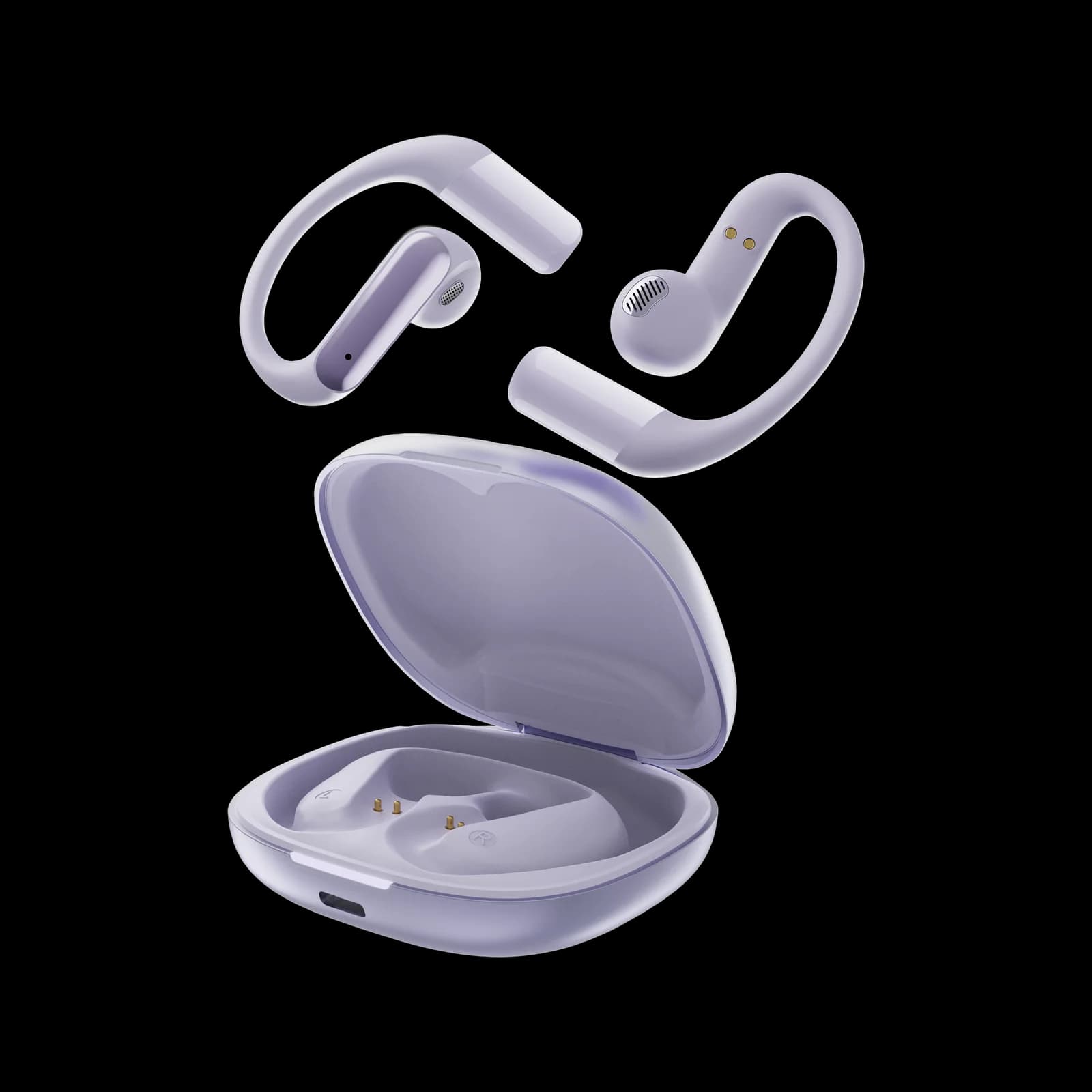
A purchase order goes out for clip-on earbuds. The sample box comes back with hooks. Nobody notices until a customer with glasses says the arm fights the loop, and by then the tooling is cut.
That's the failure the clip on vs ear hook earbuds distinction prevents. The two shapes are not two words for one object. They hold onto different parts of the ear, they fail for different reasons, and they suit different customers.
Two shapes, two load paths
A clip pinches. It grips the concha — the bowl in front of the ear canal — or the fold of cartilage just behind it, depending on the design, and it holds there through spring tension across two contact patches. Nothing goes over the top of your ear. The housing sits outside the canal opening, which is the whole point of the open-ear category.
A hook hangs. An arm sweeps over the top of the auricle and a housing rests behind or below it, so the load is carried on the rim of the ear and the skin behind it, with gravity as a co-worker rather than an adversary.
That difference decides almost everything downstream. Treat the clip on vs ear hook earbuds choice as two products rather than two names for one, and most of the specification argument resolves itself. A clip depends on the bowl being wide enough to accept it and firm enough to resist being pushed open. A hook depends on the rim being tall enough that the arm doesn't slide forward, and on the housing behind the ear not colliding with anything.
What each one collides with
Feature | Clip-on | Ear hook |
|---|---|---|
Primary load path | Spring tension across the concha | Weight hanging on the auricle rim |
Pressure point | Two small patches, front and back of the bowl | Top of the ear, plus skin behind it |
Glasses | Temple arm passes outside the clip; usually workable | Temple arm and hook compete for the same strip of skin |
Earrings | Studs fine; hoops and cuffs can be pushed outward | Studs fine; a hoop can catch the arm as it seats |
Helmet or hat | Sits under the strap; pressure is the issue, not fit | Strap lands on the arm and can lever the housing off |
Hair | Long hair catches the gap when you seat it | Hair slips under the arm; the housing stays put |
What fails first | Spring relaxes, or the bowl is too narrow to hold | Arm bends out, or the housing lifts when you look down |
Read the table as a list of customer complaints, because that's what it is. The clip's weak point is a moulded gap that can't adapt. The hook's weak point is an arm that can be bent by a helmet strap or a hood.
Why "one size fits all" is worse for clips
A hook has some tolerance built in. If the rim is shorter than average, the arm sits a little lower and the housing rests slightly further back; the bud still hangs on. A clip has almost none. The opening is moulded, the spring rate is fixed, and the ear either accepts that geometry or it doesn't.
This is why the two shapes return for different reasons. Hooks come back because they move. Clips come back because they hurt, or because they won't stay on a smaller ear at all. If your market skews toward smaller ears, that's a reason to sample clips early and in person, not a reason to assume the hook will rescue the account.
I'd go further: any supplier who answers "one size fits all" for a clip design hasn't measured enough ears. The claim is cheap to make and expensive to discover.
Five fields an RFQ needs before tooling
Most earbud RFQs describe the shape with a photo and a product name. That's how the clip and the hook get confused in the first place. Five fields fix it:
A reference photo with a scale object. Not a render on white. A photo on a ruler or beside a coin, so the reviewer can see the housing's real proportions.
The contact surface, named anatomically. "Grips the concha" and "hangs over the helix" are different specs, and a factory needs to know which one it's quoting.
The opening or gap dimension as moulded, with tolerance. For a clip this is the fit-critical number. For a hook it's the arm's inner curve.
How left and right are handled. Symmetrical housings are cheaper; mirrored ones fit better. Say which you're paying for.
Material and surface hardness at the contact patch. Soft-touch coating grips but wears; hard plastic slides but lasts. This decides whether the complaint is "falls off" or "hurts after an hour".
Add a sixth if the product will be sold into a market with heavy glasses use: ask for a sample pair tested with a 2 mm temple arm in place. It costs nothing at the sample stage and saves a mould. We quote both shapes per project through the OEM and ODM page, which is also where a sample plan gets agreed before tooling.
What we make, and what we won't claim
We build both shapes, which is why this article exists rather than a sales page. The W12 is a clip-on, and our own spec sheet lists an 11 mm driver, a 30 mAh bud with a 300 mAh case, about 55 g for the complete kit and IPX5 on the buds, all manufacturer-rated.
The G129 is our ear-hook model, and it's the one with the public compliance file. Different load path, different customer, different fit argument.
What I won't write is that either one fits everyone. Our own overnight log on the W12 records a single tester and a single ear shape, roughly ten position changes before the clip shifted enough to notice. That's a data point, not a guarantee, and any factory quoting you a fit rate without a sample protocol is quoting hope.
Three checks when you compare samples
Wear each shape for an hour, not a minute. Spring pressure and arm weight both show up late; a clip that feels fine at ninety seconds can ache at sixty.
Test with the accessories your customers wear. Glasses, a hoop earring, a bike helmet, a face mask. The collision is the spec.
Look at the contact patch after the trial. Shiny spots mean movement; red marks mean pressure. Either one tells you more than the marketing photo.
Frequently asked questions
Are clip-on and ear-hook earbuds the same thing?
No. A clip grips the concha with spring tension and never crosses the top of the ear. A hook hangs an arm over the auricle and carries the housing behind it. They're different moulds, different fit tolerances and different failure modes, and catalogues that list them under one heading are the reason samples arrive wrong.
Which is better for glasses wearers?
Usually the clip, because the temple arm runs outside the housing instead of competing for the same strip of skin above the ear. "Usually" is doing work there: a thick arm and a wide clip can still fight, which is why the sample test matters more than the category.
Can I wear ear hooks with a helmet?
Sometimes, and never comfortably for long. The chin strap tends to land exactly where the arm sits, and it levers the housing when you turn your head. If helmets are the use case, test that combination before you commit to a mould.
Do clip-on earbuds fall out?
They shift rather than fall. The clip stays hooked on the ear in most cases because the geometry traps it, but the housing rotates and the driver drifts away from the canal opening, which changes how it sounds. Our own test on one ear recorded about ten position changes overnight before that drift was noticeable.
Why do my samples fit differently from the photos?
Because the photos show one ear. Concha width and rim height vary enough between people that a design which looks universal on a render can be marginal on a real head. Ask for the moulded gap dimension and the tolerance, then test on at least three people before tooling.
Sources
G129 FCC Grant of Equipment Authorization — the public compliance document for our ear-hook model.
Our own W12 specification sheet — 11 mm driver, 30 mAh bud, 300 mAh case, about 55 g complete kit, IPX5 on the buds, manufacturer-rated.
Our first-hand W12 overnight log, 6 November 2026 — one tester, one ear shape, roughly ten position changes before the clip shifted enough to notice.
Design notes on why we build open-ear clips — the reasoning behind the shape, including what it gives up.
Retention diagnosis — what to check when a bud moves, shape by shape.
Editorial publication note: All specifications are manufacturer-rated from our own sheets; the overnight retention figure is a single-tester observation and is described as one. Nothing here claims a fit rate, a universal fit, or a measured comparison between the two shapes across a population — we have not run one. The five RFQ fields are drawn from our own sampling process, not from a standard.