
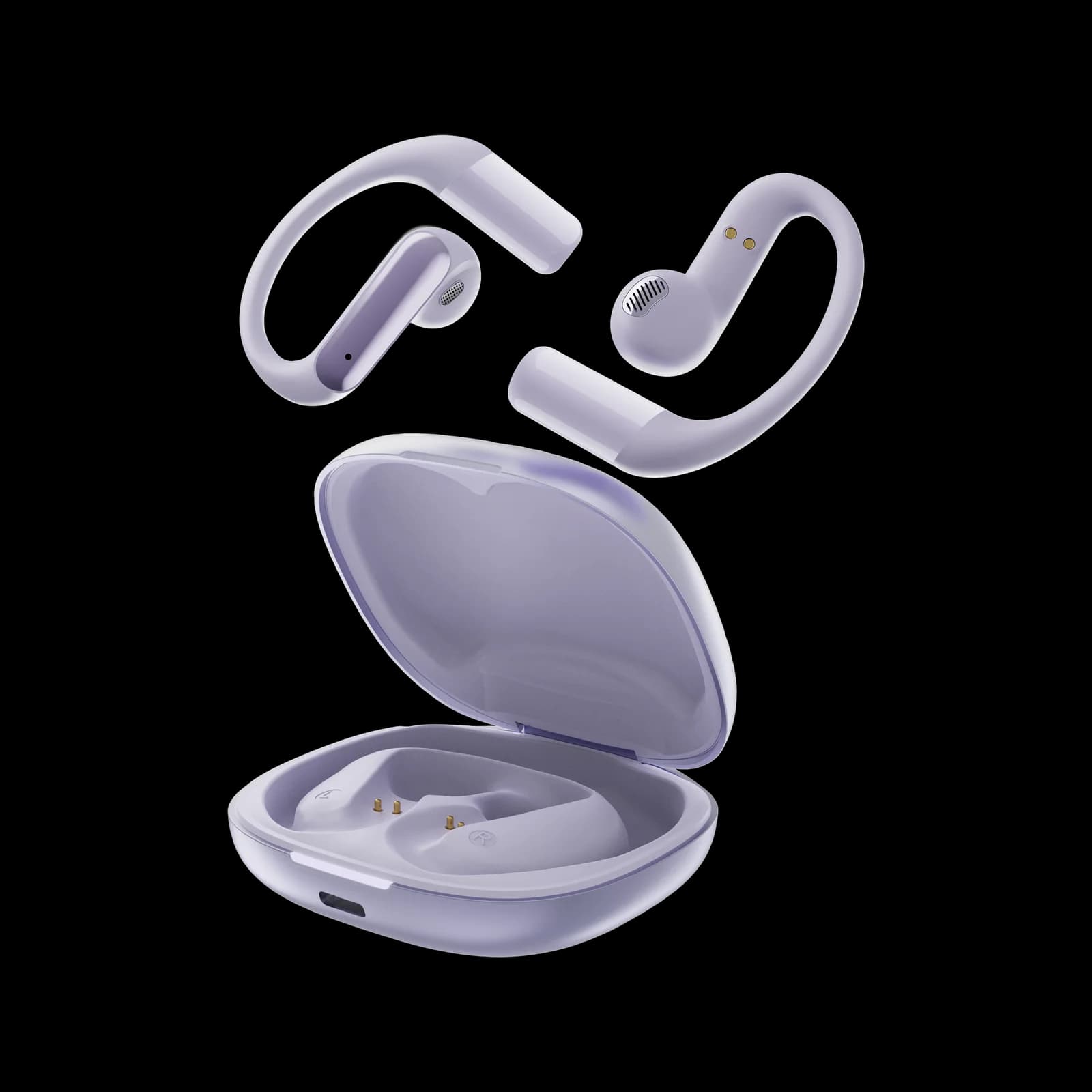
Most earbud pages describe what a product does. This one answers why open ear earbuds look like this at all — and what we chose to lose in exchange.
We build an open-ear clip design: a lightweight arm that holds a driver just outside the ear canal, gripping the outer ear rim instead of sealing anything. That single decision — no ear tip — cascades into everything else: the fit, the sound, the battery budget, the situations where the product is the wrong purchase.
The three constraints that shaped the design
Nothing in the canal. The dominant failure mode in our buyer research is not sound quality, it is discomfort: sore canals after an hour, pressure from tips, ears that cannot tolerate insertion at all. Anything that sits inside the canal inherits that problem permanently. A clip removes it structurally rather than mitigating it.
It has to survive movement. Tips rely on a seal that jaw movement and sweat break. A clip holds the ear itself, so movement does not loosen it — it just moves the whole assembly with your ear. Our own session test: zero adjustments across 60 minutes of strength work followed by a 30-minute treadmill run at console speed 7, 4% incline.
You should still hear the room. For cycling, gym floors, offices and sleeping with children nearby, sealed audio is a safety liability, not a feature. The clip is deliberately open.
What the W12 is, in numbers
The full listing, with dimensions and current variants, is on the W12 product page. The figures that shape the experience:
Specification | Value | Notes |
|---|---|---|
Bluetooth | 6.0 | Current generation link |
Driver | 11 mm full-range composite diaphragm | Sized for output at the canal opening, not for canal pressure |
Battery per earbud | 30 mAh | Small cell, because the shell has to stay light |
Charging case | 300 mAh | Top-ups between sessions |
Playback per charge | 4.5–6 h (manufacturer-rated) | Tested at ~5 h continuous at 50% volume |
Talk time | ~4 h (manufacturer-rated) | Tested at ~4 h continuous call |
Ingress protection | IPX5 | Water jets; not swimming or showering |
Kit weight | ~55 g including case | Weight is a retention factor, not a spec-sheet vanity metric |
Publishing the small numbers — 30 mAh, 4.5–6 hours — is deliberate. The category has trained buyers to expect "20 hours," which almost always means with case recharges. We would rather state the figure you will actually experience in one sitting.
What we gave up
Bass. No seal, no low-frequency pressure. There is no trick around this; a sealed in-ear bud at the same price will sound fuller on bass-heavy music. Our clip is a speech-first, awareness-first design. If your playlist is built on sub-bass, this is the wrong product, and we would rather say so than let a return teach you.
Isolation. Related, but separate: without a seal you hear the room. On a train or in a busy gym, you are competing with the environment. Sometimes that is why people buy it; sometimes it is why they return it.
Aim tolerance. Open-ear output is directional. Sitting correctly on the ear, it sounds clean; rotated half a centimetre, the high end changes. The clip geometry is designed to make the correct position the only comfortable one, but fit still varies by ear.
Who it is not for
Partner snoring. An unsealed design cannot attenuate low-frequency noise. This is the physics of it.
Loud, bass-driven listening. Buy sealed in-ears.
Absolute audio privacy. At high volume, a person very close to you can hear it.
People who want a sealed "quiet" feeling. Some listeners find open-ear audio disconcertingly thin until they adjust.
Who it tends to suit
Side sleepers with sore canals (fit notes here), people whose ears reject tips (the small-ear problem in detail), gym and outdoor training where awareness matters (format comparison), low-profile workplace listening (what actually reads as discreet), and anyone who has returned three pairs of in-ears and wants to understand why (our diagnosis of retention failures).
If your main concern is runtime rather than fit, the relevant reading is how battery claims are constructed — including why our own figure looks smaller than competitors'.
What we are still working on
Three things, honestly:
Bass without a seal. Directional driver placement and housing resonance help at the margins. Physics sets the ceiling.
Clip tension across ear sizes. One geometry cannot flatter every ear rim; we test against multiple wearers and treat fit complaints as design input.
Ear-side temperature. Any worn object warms the skin. The open design keeps the canal uncovered, which helps, but contact points still warm up over a long session.
Frequently asked questions
Do open-ear clip earbuds sound worse than in-ear?
They have less bass and less isolation. For speech, podcasts and mid-focused music the difference is small; for bass-heavy tracks it is obvious. It is a design trade, not a quality defect.
Are they secure during exercise?
In our testing, yes — no adjustment across a strength session and a treadmill run. As with any worn object, a hood or a hard contact can shift them; nothing is guaranteed.
Can I wear them with glasses?
Yes — the clip contacts the outer ear rim, not the temple arm, so the two coexist. Fit still depends on ear size and clip tension.
Can I sleep in them?
We tested a full night on one side with no soreness, and the clip shifted after roughly ten position changes. Read that as "plausible," not "certified for sleep."
Sources
SoundGuys, *The best headphones for sleeping in 2026* (ANC effective band around 20–200 Hz — the range an open design cannot address): https://www.soundguys.com/best-headphones-for-sleeping-2-164435/
SoundGuys, *Ozlo Sleepbuds 2 review* (measured passive isolation, published per frequency band): https://www.soundguys.com/ozlo-sleepbuds-2-review-161143
Editorial publication note: All figures above are manufacturer-rated from the current catalogue unless labelled as tested; the 11 mm driver and IPX5 rating were checked against the live product record on November 12, 2026. First-hand results were recorded on November 6, 2026: overnight wear (one tester, both sides), 60-minute strength session plus 30-minute treadmill run at console speed 7 / 4% incline with zero adjustments, ~5 h continuous playback at 50% volume, ~4 h continuous call, and microphone pickup measured from a 70 dB speech level to roughly 45 dB at the recording position (iPhone 15 Pro, noise reduction enabled). That microphone figure describes the recording level, not a calibrated attenuation value. We do not publish charge-temperature cut-off figures because they are not in the current catalogue.