
There is a specific kind of frustration in catching your earbud mid-air for the third time in one workout. But the useful part is what happens next: most people conclude their ears are the wrong shape. In practice, earbuds fall out for six identifiable reasons, and five of them are fixable without buying anything new.
1. The tip is the wrong size — and it is probably too small
Counterintuitive but common: people with narrow canals choose a small tip to avoid discomfort, then discover the bud slides out. A tip that is too small never builds enough contact to hold.
Light pressure is the goal, not maximum insertion. If a tip needs force to seat, it is the wrong tip — pain is not a retention strategy.
2. The shell is wider than your ear opening
Fitting advice usually stops at tip sizes. Tips change the seal; they do not change the plastic body. If the housing is wider than your ear opening, no tip swap fixes it — the bud is being held out of position by geometry, and jaw movement levers it loose.
This is the single most common cause in people who describe their ears as small. Our guide to fit problems that aren't about tip size covers how to identify it.
3. Jaw movement is working them out
Your ear canal changes shape when you talk, chew or clench. If an earbud seals only at a shallow depth, the change in canal shape breaks the seal and the bud migrates. This is why buds that stay put while you sit still fall out during a conversation or a set of heavy squats.
Depth and angle matter more than tip softness here. So does the direction of the nozzle: a bud aimed slightly forward tends to stay; one aimed straight in tends to back out.
4. Sweat and skin oils
Silicone on dry skin has reasonable friction. Silicone on sweat does not. This is why retention problems often appear in the gym and not at a desk, and why cleaning tips with a dry cloth mid-session sometimes fixes a "design flaw" instantly.
Foam tips handle moisture better than silicone in most cases, at the cost of lifespan and a slightly muffled top end.
5. The wrong format for the activity
Some activities are simply hostile to in-ear buds: running (repeated impact), burpees (inverted, head-down), cycling with a helmet strap, anything involving a hood. No tip size compensates for 3 g of earbud being accelerated downward several times a second.
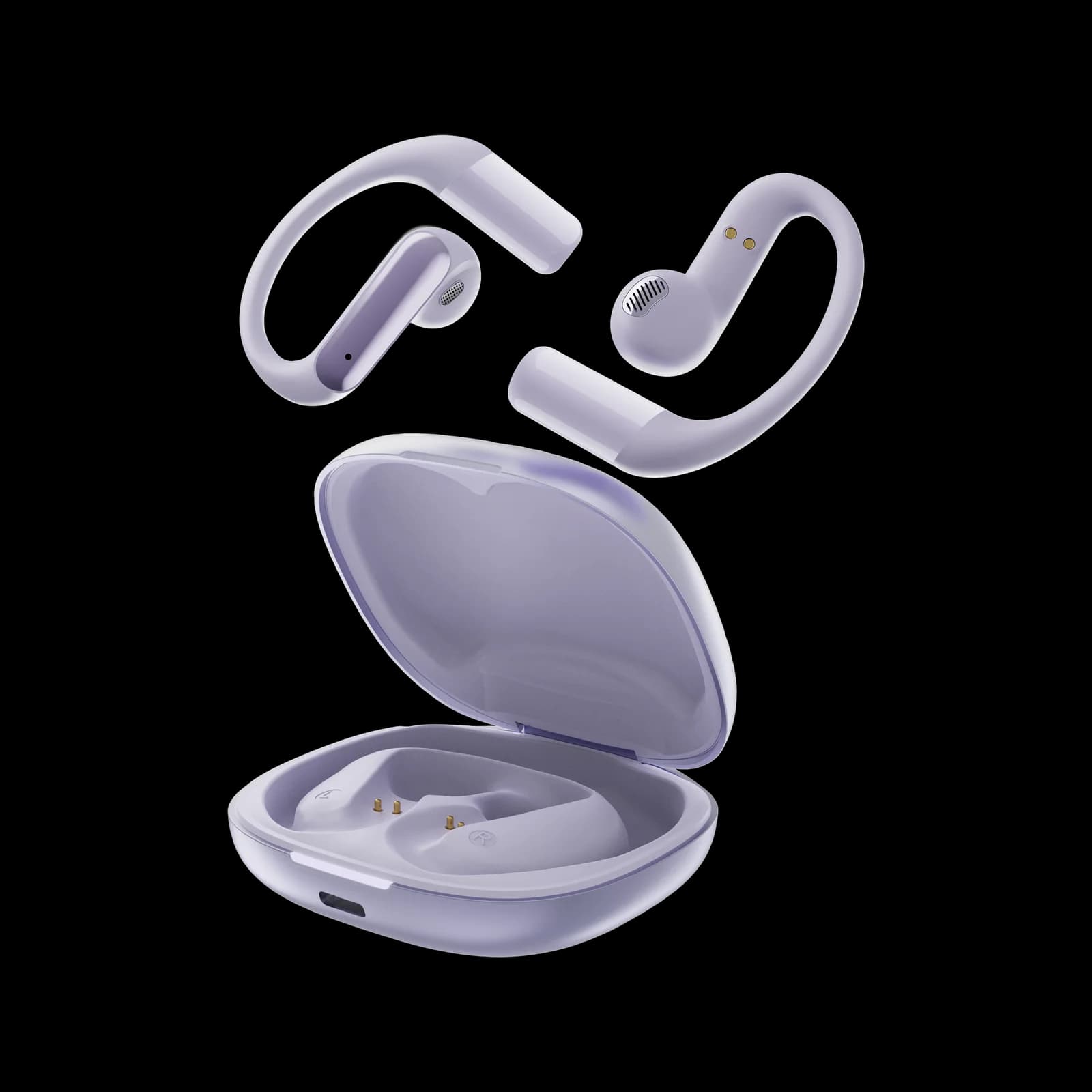
The fix is structural, not incremental. Clip-on and ear-hook designs hold the outer ear rather than the canal, so jaw movement and sweat do not dislodge them. In our own session test, the W12 clip needed zero adjustments across 60 minutes of strength work plus a 30-minute treadmill run at console speed 7 on a 4% incline. One session, one ear shape — but "no adjustment across 90 minutes" is the kind of result to look for. Our gym buying guide compares the formats by activity.
6. Earwax, and the seal you think you have
A thin film of wax on the tip reduces grip and seal without being visible. If one ear loses fit and the other doesn't, this is worth checking before anything else.
Diagnose it in five minutes
Symptom | Most likely cause | First fix |
|---|---|---|
Slips out while sitting still | Tip too small or too hard | Try the next size up; try foam |
Holds at rest, loosens while talking | Shallow insertion, wrong nozzle angle | Re-seat deeper, rotate slightly forward |
Only falls out when sweating | Silicone losing grip | Dry tips mid-session; switch to foam |
One ear only | Wax, or asymmetric canal | Clean tip and ear; swap tip sizes between ears |
Pops out during impact activity | Format mismatch | Clip or hook design |
Housing sits visibly outside the ear | Shell too wide | Different shell, not different tip |
Two of these — wax and one-ear asymmetry — are diagnosed by swapping tips between ears, which costs nothing and takes a minute.
The uncomfortable truth about "won't fall out"
No design can promise retention for every ear, every pillow and every movement. Even clip designs shift: in our overnight test the W12 moved noticeably after about ten position changes. What differs between formats is the consequence. A clip that shifts is still attached to your ear; an in-ear bud that breaks its seal ends up on the floor.
So treat retention claims as directional, not absolute — including ours.
Test retention in ten minutes, before you commit
Three checks catch most of the six causes above while the box is still returnable.
Talk while fitted. Read a paragraph aloud, then clench your jaw twice. A bud that loosens during speech will loosen during a workout; the canal changed shape and the seal did not follow.
Lean over and shake your head gently. This is the burpee problem at low intensity. Anything that survives a head-down shake has a reasonable chance in a gym; anything that shifts has already told you.
Test both ears separately. Asymmetric canals are common and are almost always misdiagnosed as "these earbuds don't fit" after testing only the side that felt wrong.
Ten minutes here saves the restocking fee, and it is the only reliable way to tell a tip problem from a housing problem.
Frequently asked questions
Why do my earbuds fall out even with the smallest tips?
Small tips reduce pressure but also grip. If the shell itself is too wide for your ear opening, tip size is irrelevant — the geometry is holding the bud out of place.
Are foam tips better for staying in?
Usually yes for retention and sweat, since foam expands to fill the canal. They wear out faster and cost more per year than silicone.
Can I make earbuds stay in during running?
Sometimes, with the right tip and angle. Repeated impact is genuinely hard on in-ear retention — if you have already tried tip sizes, an ear-hook or clip design is the more reliable route.
Do clip-on earbuds ever fall off?
They can shift on the ear, especially during sleep or with a hood. Because they are held by the outer ear rather than seated in the canal, they rarely end up on the floor.
Sources
SoundGuys, *The best headphones for sleeping in 2026* (per-bud dimensions and weight used to judge how far a housing protrudes): https://www.soundguys.com/best-headphones-for-sleeping-2-164435/
SoundGuys, *Ozlo Sleepbuds 2 review* (11 mm × 17 mm × 12 mm, 1.6 g per bud — the flush-fit reference point): https://www.soundguys.com/ozlo-sleepbuds-2-review-161143
Editorial publication note: The session observations cited (zero adjustments across 60 minutes of strength work plus a 30-minute treadmill session at console speed 7 / 4% incline; ~10 position changes before a sleep shift) are first-hand results recorded on November 6, 2026, on a single unit and tester. Do not generalise them into a retention guarantee. The causes listed are fit mechanics, not manufacturer claims from any brand.