
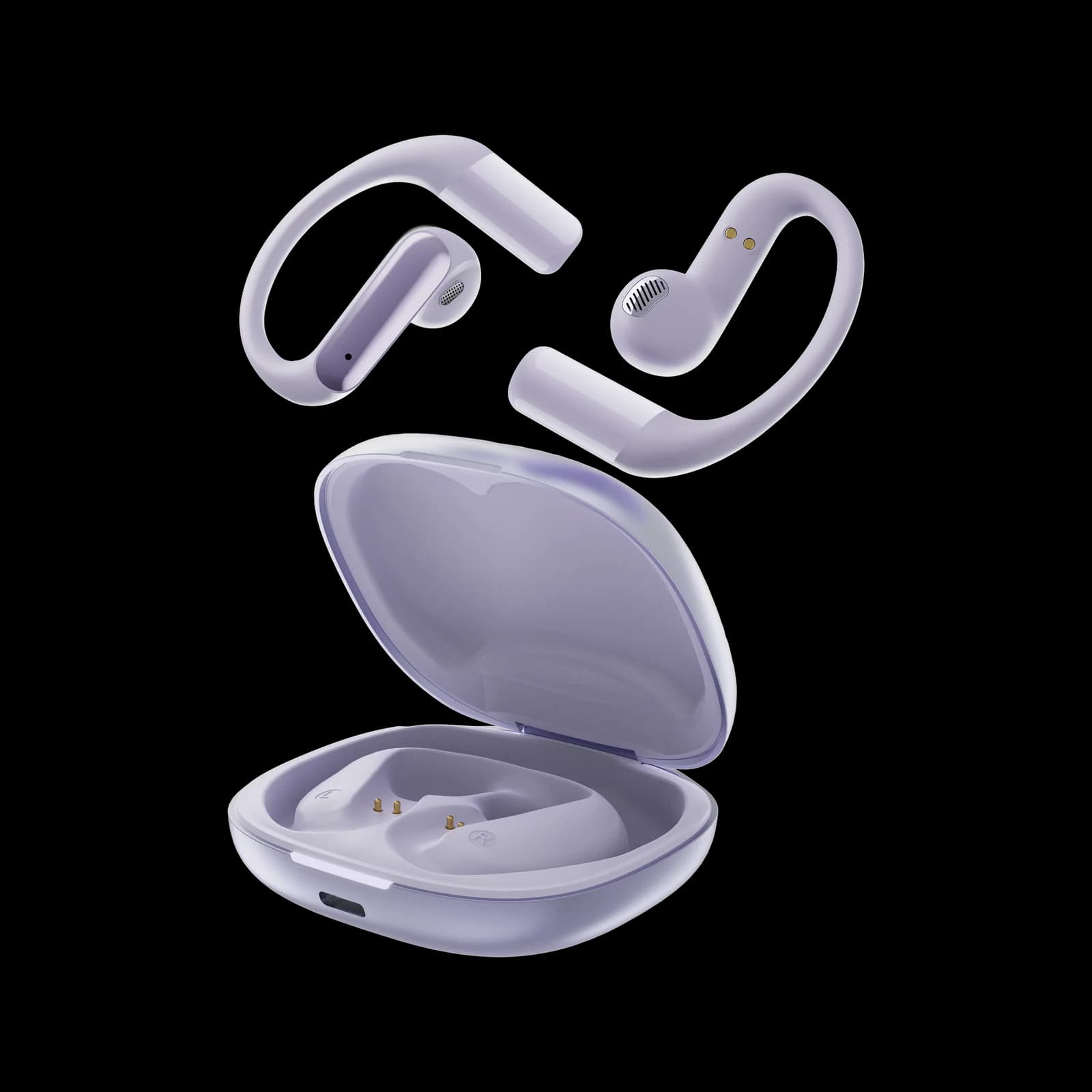
The phrase “discreet earbuds for work” can mean different things. Some people want a compact pair for calls in a shared office. Others need a comfortable option for listening during permitted downtime. In either case, appearance is only part of the decision.
A low-profile earbud may be less conspicuous, but poor microphone quality can make a phone call obvious to everyone nearby. An open-ear design may look different from a conventional earbud while making it easier to hear coworkers. The most suitable option depends on your workplace, the task and the way you plan to use it.
Before buying, check your employer's rules. Earbuds may be restricted in customer-facing, operational or safety-sensitive roles, even when a particular design is small or leaves the ear canal open.
What makes an earbud look discreet?
The overall silhouette matters more than the marketing label. Consider the color, size, shape and how far the device extends from the ear.
Compact in-ear earbuds
Small in-ear models sit close to the ear and are available in neutral colors. A short or rounded housing may be less noticeable than a model with a prominent stem. However, a close fit can still be visible from the side, and a sealed design may make it harder to hear people speaking nearby.
Low-profile true wireless earbuds
True wireless earbuds with a compact shell can avoid the long stem associated with some familiar designs. Look at side-view photos rather than relying on product names such as “mini” or “invisible.” A product marketed as invisible may still be easy to notice at conversational distance.
Open-ear and clip-on earbuds
Open-ear earbuds keep the ear canal unsealed. Some clip-on models attach to the outer ear and have a different profile from traditional in-ear products. They may be useful when you need to hear the room, but their appearance varies considerably: a clip can be more visible than a small in-ear bud.
That awareness advantage is the same reason open-ear designs are popular for training and outdoor movement — our guide to earbuds for workouts covers where hearing your surroundings is a feature rather than a compromise. At a desk, the equivalent benefit is hearing a coworker approach without pulling an earbud out mid-sentence.
Open-ear also does not mean private. Sound can be audible to people nearby, especially at higher listening levels or in a quiet office.
The microphone can reveal more than the earbuds
If you use earbuds for work calls, microphone performance should be a major part of the buying decision. A compact design is not necessarily equipped with a good microphone, and a feature described as “noise reduction” may refer to playback noise cancellation rather than microphone noise suppression.
Look for clear information about:
Microphone count and placement.
Voice pickup or microphone noise-reduction features.
Call performance in quiet rooms and noisy environments.
Compatibility with your computer or phone's calling software.
Whether the microphone can be muted from the earbud itself.
Terms such as ENC and cVc are not enough on their own to prove call quality. If possible, listen to unedited microphone samples or test the earbuds on a call in the environment where you expect to use them.
This is the one claim worth verifying before you rely on it, because it is the easiest to overstate. As an example of the disclosure we consider sufficient: our own W12 clip-on model is rated for roughly 4 hours of talk time per charge — and our own continuous-call test ran right at four hours before shutdown. For pickup quality, we measured a normal speaking voice at about 70 dB in the room, and a recording made on an iPhone 15 Pro with the W12's smart noise-reduction enabled read roughly 45 dB on a sound-level meter app. Same phone, same room, unedited settings — conditions first, headline number second. A seller who publishes that kind of test detail alongside the claim is giving you something you can actually judge; a seller who only says "HD calling" is not.
Choosing earbuds for different work environments
Quiet office or home workspace
In a quiet environment, compact in-ear earbuds may be suitable for private listening and calls. If you share a room, consider whether audio leakage could disturb colleagues. A lower volume and a well-fitting sealed earbud can help, but test at your normal listening level rather than assuming privacy from the product description.
Customer-facing work
If you need to respond to customers or coworkers, situational awareness and workplace expectations matter more than an “invisible” appearance. A single-ear listening setup may be permitted in some workplaces, but you should follow the actual policy rather than assume it is acceptable.
Warehouse, workshop and other safety-sensitive roles
Do not use earbuds where they could prevent you from hearing instructions, alarms, vehicles or machinery. Open-ear designs do not automatically make listening safe in these environments. Follow site rules and required hearing-protection procedures.
Five features worth comparing
Low-profile shape: Check front and side photos, dimensions and color options.
Call microphone quality: Look for real voice samples and independent call tests.
Sound leakage: Check whether nearby people can hear audio at your intended volume.
Comfort over a full session: Compare weight, ear-tip options and pressure points.
Device compatibility: Confirm support for your laptop, phone and conferencing applications, including multipoint if you switch devices frequently.
Battery life is another practical consideration. Compare playback time with the microphone or other features enabled if you expect to use the earbuds for calls throughout the workday. A headline battery figure may describe music playback under different conditions — the gap can be substantial. Our W12 clip-on, for instance, is rated for 4.5–6 hours of music playback per charge but roughly 4 hours of talk time, and music and talk time are measured differently for most models. Budget your workday against the talk-time figure if calls are your main use.
Are discreet earbuds worth buying for the office?
They can be, if your workplace allows them and the design matches the job. A small earbud with a weak microphone may be a poor choice for frequent calls. An open-ear model may suit someone who needs to hear nearby conversation, but it may not provide the audio privacy required in a shared space.
Think about the task first, then choose the style. The goal should be reliable, comfortable audio that fits your work environment—not simply a device that is difficult for someone else to notice.
Frequently asked questions
What are the most discreet earbuds for work?
Compact in-ear earbuds with a small housing and neutral finish are often less visually prominent than large stem-style models. Clip-on and open-ear products have different shapes and may be more visible depending on the design. Compare real product photos rather than relying on “invisible” claims.
Are open-ear earbuds suitable for an office?
They can be useful when you want to hear nearby conversation, but they may leak sound. In a quiet shared office, keep the volume low and consider whether colleagues can hear your audio. Follow workplace rules.
What should I look for in earbuds for work calls?
Prioritize microphone clarity, background-noise handling, mute controls, device compatibility and performance in your actual work environment. Marketing terms alone do not establish call quality.
Can I wear one earbud at work?
That depends on your employer's policy and the nature of your role. Some tasks require full awareness of the environment, and some workplaces prohibit earbuds entirely. Check the rules before using them.
Do small earbuds have good microphones?
Some do, but size does not predict microphone quality. Look for independent call samples and tests that describe the room noise, device and calling platform used.
Editorial publication note: W12 talk time (rated ~4 h; continuous-call test also ran ~4 h) is manufacturer-rated plus first-hand verified as of November 6, 2026. Microphone figures (70 dB speech level in room; ~45 dB recording level on an iPhone 15 Pro with noise reduction enabled, sound-meter app) reflect our test conditions as stated. Unedited voice samples are recommended as a further upgrade but conditions are disclosed per Google's people-first guidance. Do not promise that an earbud is invisible or undetectable.