
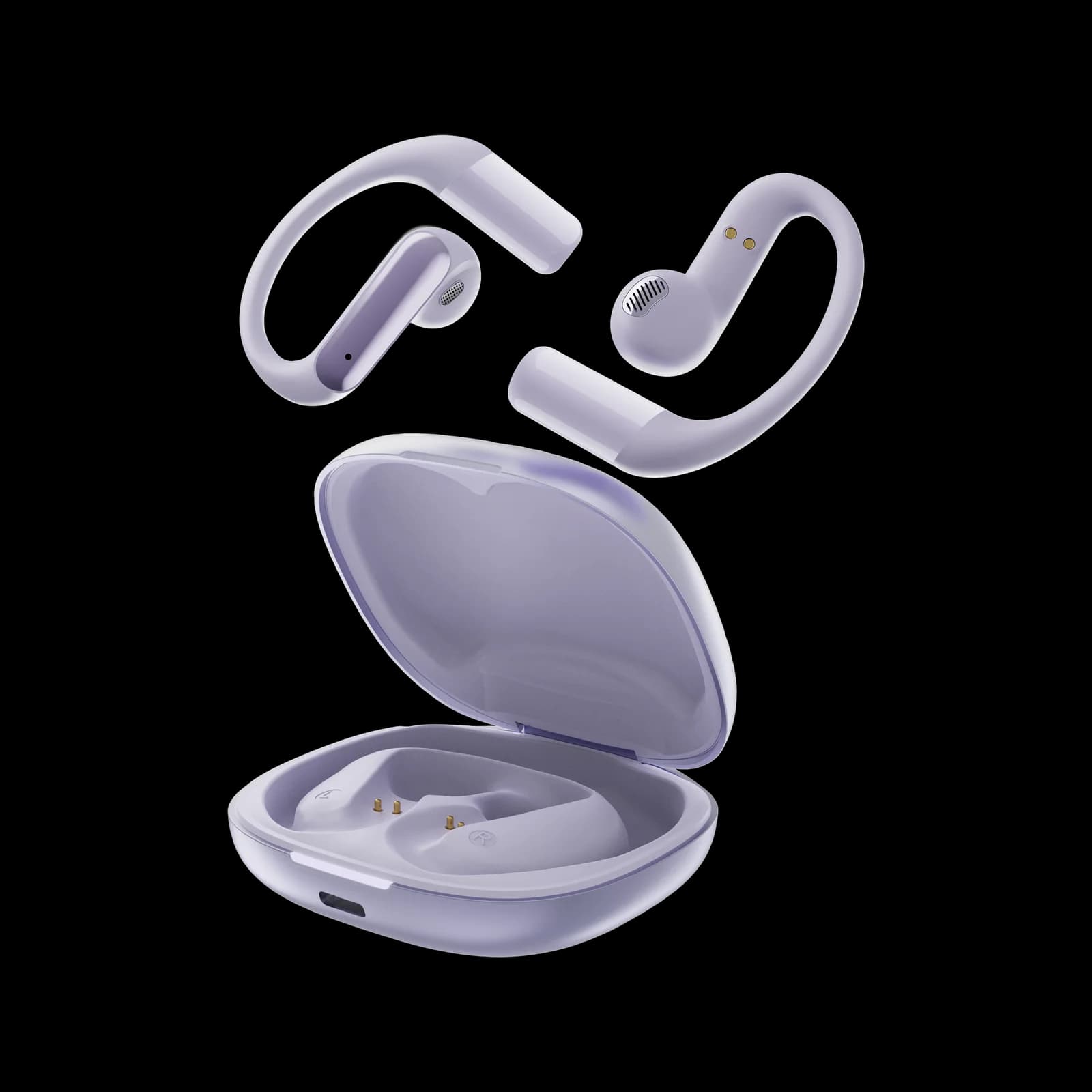
You clip the earbud on, it feels fine. Then you put in your helix ring, and something clicks that shouldn't click. Or nothing clicks, but by the third hour there is a dull ache at the top of your ear and you can't work out whether it's the clip or the ring.
Most advice on this problem is styling advice, which is the second half of the problem. The first half is mechanical: two objects are competing for the same piece of cartilage, and only one of them can win.
Where the clip actually sits
A clip-on holds the outer ear — the rim and the hollow just inside it, roughly between the upper lobe and the antihelix. It holds by spring pressure, which means it needs continuous contact over a small area.
Where it does not sit is the lobe. That is the whole reason the format works with jewelry: your first and second lobe piercings are untouched, and a stud or a small hoop is invisible to the earbud.
The conflict zone is everything above that. Helix, forward helix, conch, daith, rook, industrial — each of those occupies cartilage the clip wants to grip. A hoop in the mid-helix and a clip on the antihelix will physically overlap on most ears.
Which piece has to move
What you already wear | Conflict level with a clip | What usually solves it |
|---|---|---|
Lobe stud or small hoop | none | nothing — leave it |
Second or third lobe piercing | none | nothing |
Small helix stud, high up | low | rotate the clip slightly forward |
Helix hoop, mid-ear | high | move the ring to the other ear, or switch to a stud |
Conch ring | high | clip the other ear |
Daith or rook ring | low to medium | usually clears, but test before trusting |
Industrial bar | very high | not compatible on that ear |
Ear cuff jewellery | high on the upper ear | wear the cuff on the opposite ear |
Two clips in one ear is worth mentioning because people try it: the arms cross each other behind the ear and the pressure doubles. It's a styling idea that fails mechanically.
The three-step contact test
Do this before you wear the combination out of the house, because the failure mode is slow and cumulative rather than immediate.
Earbud alone. Wear it for ten minutes doing something normal — cooking, typing, walking. Note any pressure point. If there's already pressure, adding jewelry will not improve it.
Add the ring. Put the earring in with the earbud still on. Listen for a click or a rub when you turn your head, and feel for one piece hooking the other.
Side profile in a mirror. Not the front view. Turn your head ninety degrees and look at how the two objects sit relative to each other. If they overlap visually, they're probably overlapping physically.
The stop rule matters more than the test: sustained pressure, an audible rub, one piece catching on the other, or pain at a piercing site means take one of them off. Do not wait for it to settle. It doesn't settle — pressure on cartilage gets worse over hours, not better, and the soreness can outlast the day by a week.
Once they coexist, make it look deliberate
Five objects on one ear reads as a curated stack or as clutter, and the difference is entirely down to a few rules that jewelry stylists keep repeating.
Pick one anchor. Either the earbud is the loudest thing on the ear or your statement earring is. Both at once and the eye has nowhere to land. Harper's Bazaar's ear-cuff guide puts it the same way: start with one hero piece and build around it with smaller items, and let the hero set the tone for everything else.
Keep one metal temperature. Silver earrings with a silver-toned device, gold with gold. Mixing metals across the ear reads as accidental unless the whole outfit mixes them on purpose.
Leave a gap. The earbud needs one empty position next to it. Bare skin between the clip and the nearest earring is what makes the arrangement look layered instead of packed.
Use asymmetry on purpose. Wearing the clip on one ear and a fuller stack on the other is a legitimate choice, and it solves the crowding problem completely. Just make the difference obvious — a half-difference looks like a mistake.
Match the hair. Hair down over the ear hides both the clip and the earring, which defeats the point. If you've built a stack, wear the hair back on that side.
Clip pressure is the other half of this problem, and it isn't about jewelry at all. On a small ear, the arm that holds an average ear can feel tight — the fit side of the question is worth reading before you decide the format doesn't work for you.
The one thing nobody tells you about which ear
Your phone is probably held to one ear, your bag strap hangs off one shoulder, and you sleep on one side. Clip the earbud on the ear you don't hold the phone to, if you take a lot of calls — otherwise the mic is on the side where your hand and the phone speaker both are.
For one-ear-at-a-time listening, both our W12 and the KT01 are the same shape family: an 11 mm driver in a C-arm clip, Bluetooth 6.0, with the W12 rated IPX5 and 4.5–6 hours of playback per charge. Neither model cares which ear it's on for audio, which is what makes single-ear wearing practical.
Honest limits
If your helix ring sits in exactly the spot the clip wants, no amount of styling fixes it. Move the jewelry to the other ear, or accept that this particular ear is jewelry-only.
And a clip is not gentle by default. It grips. A full night's wear on one side produced no soreness for us in a single overnight test, but that was one tester, one ear shape, and no cartilage piercing in the contact zone. With a fresh helix piercing, the calculation is different and the answer is usually: wait for it to heal.
Buying checks
Put the clip on before you decide anything. If it pinches in the first minute, no earring arrangement will save it.
Check whether the arm is rigid or has some flex. Rigid arms hold better on large ears and hurt more on small ones.
If you wear a ring in the conch or a hoop in the helix, ask which ear the seller's fit photos show, and look closely at whether that ear is wearing jewelry.
Decide your anchor before buying. If your statement earrings are the point, buy the least visible clip you can find — which is a different brief from buying one that reads as jewelry on purpose.
Frequently asked questions
Can you wear ear clip earbuds with hoop earrings?
With lobe hoops, yes — the clip sits above them and doesn't touch. With helix hoops, usually not on the same ear, because both want the same cartilage. Move the hoop to the other ear.
Do clip-on earbuds damage cartilage?
Pressure, not the device, is the risk. Any clip that presses hard for hours leaves the area tender, and cartilage is slow to forgive that. If it hurts within the first ten minutes, it will hurt more later — take it off rather than pushing through.
Can you wear an earbud and earrings on the same ear for a whole day?
Lobe jewelry plus a clip, generally yes. A clip plus cartilage jewelry in the contact zone, usually no. The middle ground is a small stud high on the helix, with the clip rotated slightly forward.
Which ear should you wear a single clip-on in?
The one you don't hold your phone to, if you take a lot of calls. Otherwise, follow your hair parting and whichever side you photograph — the point of wearing one is usually that it's visible.
Does the clip work with an ear cuff on the other ear?
Yes, and it's the most reliable way to get a layered look without conflict: device on one ear, cuff and stack on the other. Keep the metal tone consistent across both.
Sources
Bose, Ultra Open Earbuds — cuff-shaped design that hooks around the outside of the ear, IPX4, up to 7 hours: https://www.bose.com/p/spatial-audio-earbuds/bose-ultra-open-earbuds/ULT-HEADPHONEOPN-WHTSM-WW.html
Harper's Bazaar UK, ear cuff trend and styling rules — anchor piece, one metal tone, spacing, asymmetry, "snug but should not pinch": https://www.harpersbazaar.com/uk/fashion/jewellery-watches/a73190098/best-ear-cuffs-jewellery-trend-of-the-summer/
Huawei, FreeClip — C-bridge arm that wraps the outer ear, 5.6 g per earbud: https://consumer.huawei.com/uk/headphones/freeclip.html
Editorial publication note: The W12 and KT01 specifications quoted (11 mm driver, Bluetooth 6.0, IPX5 and 4.5–6 h playback for W12) are manufacturer-rated from the catalogue. The overnight comfort observation is a single first-hand test on 2026-11-06: one tester, one ear shape, no cartilage piercing in the contact zone. It is not a claim about pierced ears. Nothing in this article is medical advice about piercing aftercare.