
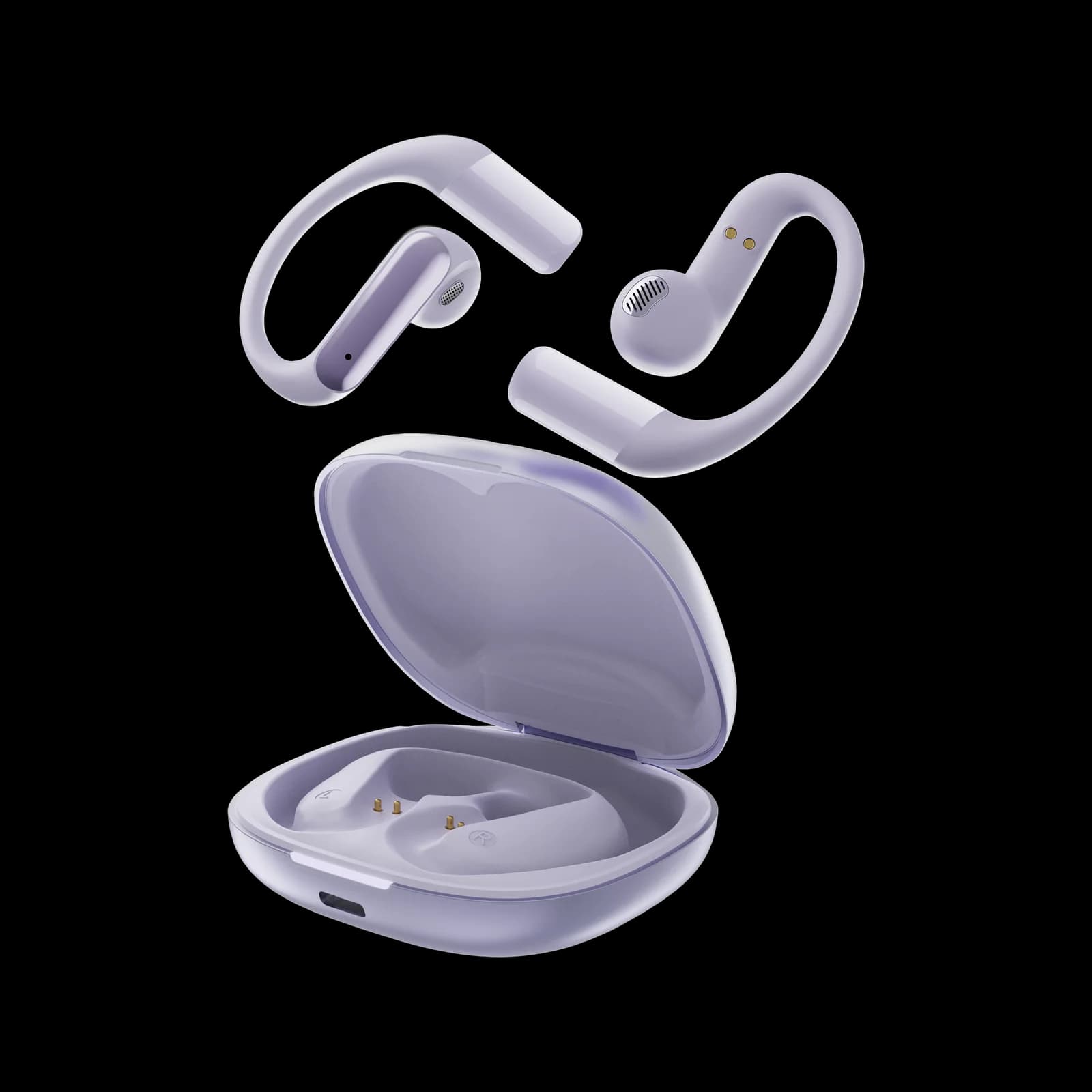
Before the earbud exists, the ear is already occupied. There's a hairstyle that may or may not cover it, at least one earring, often a pair of glasses, and a layer of make-up or sunscreen on the skin the device will sit against. Then a bud shows up and asks for the middle of all that.
That's the honest starting point for this question. Not "women's ears are smaller" — we have no ear-measurement data and wouldn't publish a claim like that — but that the ear is a busier place than a product spec assumes, and different formats handle a busy ear with varying grace.
What actually changes with the clip format
A sealed in-ear has to occupy the canal and usually the concha. That's the centre of the ear, the part your earrings sit below and your glasses arm passes over. A clip holds the outer rim and leaves the canal open.
Three consequences follow, and only one of them is about comfort.
The lobe stays usable. Lobe piercings are untouched, which is the difference between "wear both" and "choose one".
Nothing enters the canal. If small ear canals have made in-ears uncomfortable — a common complaint, and a fit problem we've written about separately — this format sidesteps it entirely rather than solving it.
The device is visible. That's the cost. A plug can be hidden by hair falling forward; a clip sits where a hairstyle is either deliberately exposing it or accidentally hiding it.
The jewelry industry has spent years making the same trade legible to buyers: Harper's Bazaar's ear-cuff coverage describes the appeal as "the impact of an additional piercing without the commitment, healing time or needle". A clip-on earbud inherits that sentence almost by accident, because holding a small speaker to the outer ear and holding a piece of metal there are the same engineering problem.
The five constraints, and what to check
Constraint | What it actually means | What to check before buying |
|---|---|---|
Earrings already there | clip above the lobe is fine; helix or conch jewellery is not | where the arm grips, and your piercing positions |
Glasses or sunglasses | temple arm and clip want the same skin behind the ear | try on with your glasses, not without |
Hair up or down | up exposes the device; down hides it and the earrings | decide which you want visible |
Make-up and sunscreen | plastic and silicone both collect foundation | material, and whether it wipes clean |
Bag space | case size, not bud size, is the practical limit | case dimensions in mm, not "compact" |
The glasses point is the one that surprises people. Our notes for people who wear frames go through it in detail, but the short version is that a clip and a temple arm can coexist if the clip sits slightly forward, and cannot if both want the same millimetre.
The weight question, honestly
Weight is the number this category leans on hardest. Huawei quotes 5.6 g per earbud for the FreeClip and built its comfort claim on it; Bose's open-ear model lists its bud at roughly 6 g by our conversion of the published imperial figure.
We do not publish a per-bud weight for our own clip models. The W12 figure in our catalogue, roughly 55 g, is the complete kit with the charging case — quoting it as a bud weight would be wrong, and I'd rather give you the gap than a number that flatters us.
What we can say is what the format does: the arm grips the outer ear, so the mass hangs off cartilage rather than sitting in the canal. That's a different sensation from a bud, not automatically a better one. It's the difference between an earring and an earplug, and people who dislike one often like the other.
Where the accessory question comes up
Because the clip's arm is exposed rather than buried in the ear, the format is the one that can be worn with something decorative on the same arm — a clip accessory, a small charm, an ear cuff sitting beside it rather than fighting it. Buyers ask about this more than about any specification, and it's the reason the clip category has drifted towards jewelry vocabulary while in-ears stayed in gadget vocabulary.
Two caveats worth stating plainly. Decorative attachments that add weight change the balance of the arm, and balance is what keeps the thing on. And a decoration that covers the microphone port or the driver grille will cost you call quality and treble — check the port positions before attaching anything.
Where to start on the styling side depends on what you want: if you want it to read as jewelry rather than hardware, that's a different shopping brief from wanting it to vanish in a formal setting.
Honest limitations
A clip presses. On a small ear, the same arm that feels secure on an average one can feel tight, and there's no size adjustment on most models — the arm either has give or it doesn't. Overnight wear on one side produced no soreness in a single test we ran on 2026-11-06, on one tester's ear shape, with no cartilage piercing in the contact zone. That's a data point, not a promise about your ear.
Second: this format doesn't isolate. In an open-plan office, a café or a train, the room arrives with the audio. If your actual requirement is quiet, an open-ear is the wrong instrument and a sealed in-ear with ANC is the right one — the trade is set out in our comparison of the two formats in practice.
Buying checks
Try it with your glasses on. Every clip feels fine without a temple arm in the way.
Ask for the case dimensions. If it doesn't fit the bag you carry, the battery life is irrelevant.
Confirm the housing material if make-up smudging bothers you — smooth TPU and soft-touch coatings behave differently from gloss plastic.
Check whether the arm has flex. Rigid arms hold better on larger ears; flexible ones are kinder on small ears.
Decide the visibility question first: jewelry or nothing at all. The two briefs lead to opposite products.
Frequently asked questions
Do open ear earbuds fit small ears better?
Often yes, because fit no longer depends on canal size — nothing enters the ear. What it depends on instead is the outer ear's thickness where the arm grips, which varies too. Look for a flexible arm rather than assuming "open-ear" means "fits everyone".
Can you wear open ear earbuds with earrings?
With lobe earrings, yes — the clip sits above them. Cartilage jewellery in the same spot is the conflict, and it's physical rather than stylistic. The contact test and layering rules cover how to check before committing.
Are clip-on earbuds uncomfortable after a few hours?
They can be, if the arm is too tight for your ear. The signal is pressure within the first ten minutes; it doesn't fade with time. A comfortable clip feels barely present at the twenty-minute mark.
Will earbuds ruin your make-up or vice versa?
Foundation and sunscreen transfer onto plastic and silicone, and matte soft-touch surfaces show it more than gloss. It wipes off; what it won't do is stay invisible between cleanings. Silicone parts can be washed, housings should be wiped rather than soaked.
Do clip-on earbuds stay in during exercise?
Our own session test — 60 minutes of strength work plus a 30-minute treadmill run at console speed 7 with a 4% incline — needed zero adjustments, on one tester. Dancing, cycling and contact sport are different loads we haven't measured.
Sources
Huawei, FreeClip product page — 5.6 g per earbud, C-bridge shape, colours, engraving service, IP54 buds: https://consumer.huawei.com/uk/headphones/freeclip.html
Bose, Ultra Open Earbuds — cuff-inspired shape, gold plating, bud dimensions and weight, IPX4, up to 7 hours: https://www.bose.com/p/spatial-audio-earbuds/bose-ultra-open-earbuds/ULT-HEADPHONEOPN-WHTSM-WW.html
Harper's Bazaar UK, ear cuff trend — "impact of an additional piercing without the commitment", Completedworks ear-cuff views up 45%: https://www.harpersbazaar.com/uk/fashion/jewellery-watches/a73190098/best-ear-cuffs-jewellery-trend-of-the-summer/
Editorial publication note: W12 figures (11 mm driver, Bluetooth 6.0, IPX5, 4.5–6 h playback, ~55 g complete kit) are manufacturer-rated from the catalogue; we publish no per-bud weight for our own models and say so in the text. First-hand data is limited to the 2026-11-06 session — overnight wear on one side, and 60 minutes of strength work plus a 30-minute treadmill run, both on a single tester with one ear shape. We hold no anthropometric data on ear size by sex and make no claim about it.