
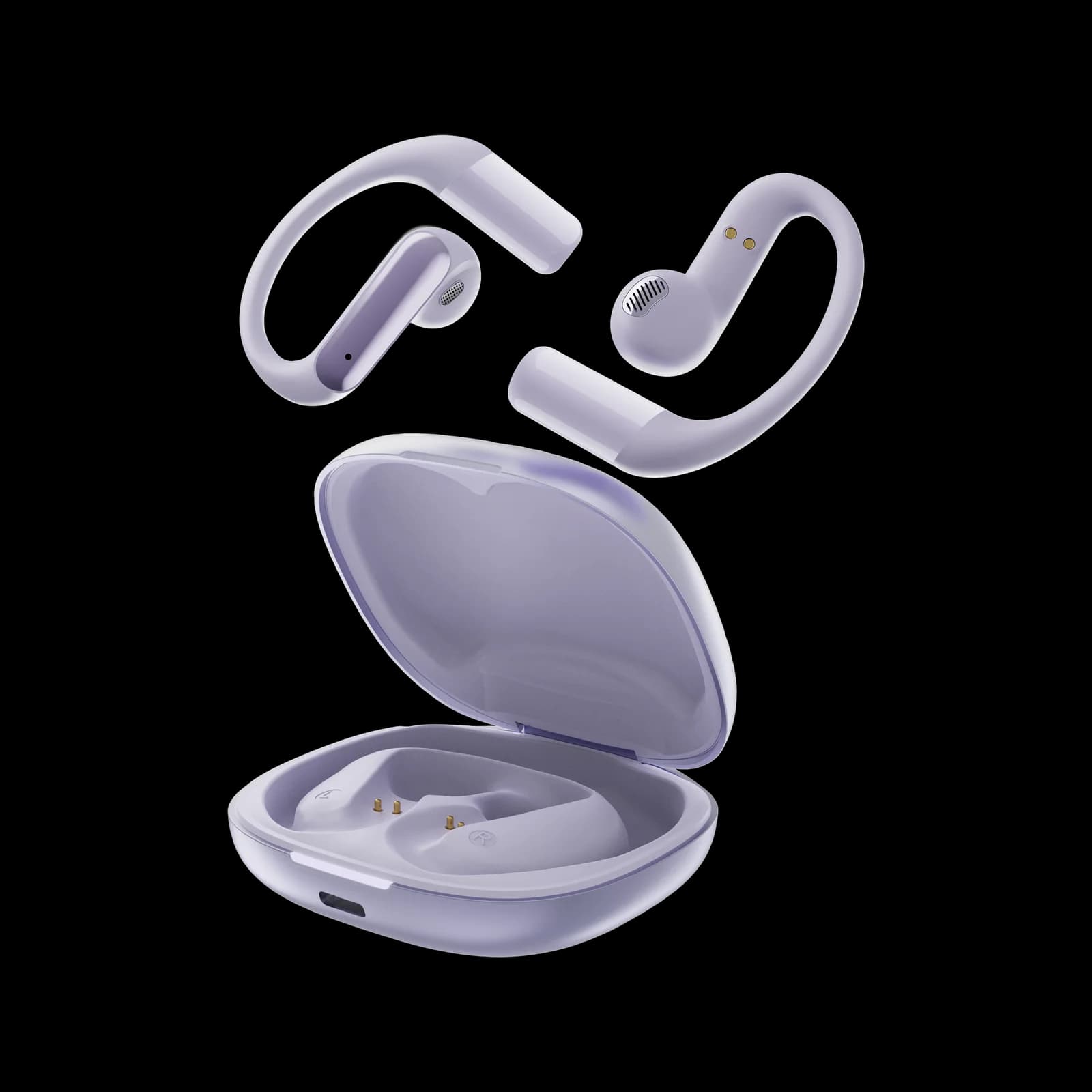
You take a photo of yourself in the mirror, the clip looks fine, almost elegant. Then a friend sends you a picture from lunch and there it is: a black plastic comma stuck to your ear, reading as a gadget from three metres away. Nothing about the earbud changed between those two images. The viewing distance did.
So the useful question isn't "do these look like earrings". It's which properties survive being seen from across a table, in daylight, at an angle you don't control.
The four things that decide it
An earring reads as jewelry because of silhouette, finish, scale and the absence of a logo shouting at you. A clip-on earbud has all four of those variables, and most models get two of them wrong.
Silhouette. Earrings are closed shapes — a hoop, a stud, a cuff that wraps. Earbuds are usually built around a stem or a bulb with a microphone hole, and that asymmetry is what the eye picks up first. A clip-on with a C-shaped arm is closer to an ear cuff than to anything in the headphone aisle, which is exactly the comparison Bose reaches for: the company describes the Ultra Open Earbuds' shape as "inspired by ear cuff jewelry" on its own product page.
Finish. Glossy black plastic reflects light like a phone case. Brushed or plated metal reflects it like a ring. Bose lists gold plating among the Ultra Open's materials, and Huawei sells the FreeClip in three colours including a rose gold that comes with an engraving service. Neither is decoration for its own sake — a warm metal tone is what lets the device sit next to real jewelry without announcing that it isn't.
Scale. An earbud that is large relative to your ear reads as equipment. Huawei quotes 5.6 g per bud for the FreeClip and leans on how small that is in its own marketing. Weight is a rough proxy for volume here, which is why it's the number brands quote.
Branding. A visible logo at conversational distance ends the illusion immediately. This is the cheapest thing to fix and the one most brands won't.
The distance test
Viewing distance | What the eye registers | What decides the result |
|---|---|---|
20 cm (mirror) | surface, edges, logo | finish and print quality |
1 m (conversation) | overall shape | silhouette, whether the arm looks structural or decorative |
3 m (photo, table) | a dark or light mark near the ear | contrast against skin and hair, nothing else |
wedding-photo distance | almost nothing | presence or absence of a hard highlight |
Read that table downwards and the priorities invert. Up close, finish matters. From across a room, only contrast matters — which is why a matte dark clip on dark hair disappears and the same clip on blonde hair reads as a small dark shape.
Why the clip format gets closer than in-ear designs
An in-ear bud plugs the canal, so it has to occupy the concha and usually protrudes. A clip holds the outer ear instead, which frees the canal and — more to the point — leaves the lobe completely clear.
That last part is the practical reason clip-ons get worn with jewelry at all. Your lobe piercings stay usable. The device occupies a zone that most people leave empty, and it occupies it in a shape that already exists in jewelry vocabulary: the ear cuff.
Harper's Bazaar's jewelry coverage this year makes the same observation from the other direction, noting that ear cuffs offer "the impact of an additional piercing without the commitment, healing time or needle". A clip-on earbud accidentally inherits that argument. It's not that someone designed a headphone to look like a cuff. It's that the most comfortable way to hold an open-ear speaker to your ear happens to be a cuff.
The commercial version of that logic already exists: Bose has sold a co-branded Ultra Open Earbuds with the jewelry label Kendra Scott, priced at $199 against a $349 list. Whatever you think of the product, the positioning is unambiguous — audio sold through a jewelry brand's credibility.
Whether the format suits your ear at all is a separate question from whether it looks good on it. Earrings, glasses, a hairstyle and a make-up routine all change the answer, which is why we keep a separate guide to open ear earbuds for a busy ear.
What our own model does and doesn't do
Our W12 clip is a C-arm design: 11 mm driver, Bluetooth 6.0, IPX5, and roughly 55 g for the complete kit including the charging case. The arm holds the outer ear rim, so the lobe stays free for whatever you already wear there.
Two honest limits. First, we don't publish a per-bud weight for the W12, only the complete-kit figure — so I can't give you the one number that would let you compare it to a 5.6 g competitor. Second, the housing is engineering plastic, not plated metal. From a metre away that's fine. In a photograph taken at 20 cm with a flash, it will read as a well-made plastic object, because it is one. If you want something that survives macro photography next to gold, this is not that product category.
What the clip format does give you is a shape that doesn't compete with your earrings, and a fit that doesn't depend on your canal size. If what you actually want is for nobody to notice anything on your ear at all, that's a different problem — and a harder one — covered in our guide to wearing audio without it being obvious at work.
Buying checks before you decide
Take a photo from a metre away, in daylight, at a three-quarter angle — not a mirror selfie. That is the view everyone else gets.
Ask whether the finish is painted plastic or plated metal. Both are legitimate; only one behaves like jewelry under light.
Check what the arm does when it's off your ear. If it hangs open like a clamp, it will look like a clamp when worn.
If you already wear a helix ring, test for physical contact first. A hoop in the mid-helix and a clip on the antihelix want the same cartilage, and no styling fixes an overlap.
Decide whether you want the device noticed or not. "Jewelry-like" and "invisible" are opposite goals and no single product delivers both.
Frequently asked questions
Are there earbuds that actually look like earrings?
Yes — the ones built on a cuff or clip shape rather than a stem. The category has grown enough that jewelry brands now collaborate on it, and Huawei offers engraving on one of its clip models. The result looks like a sculptural ear cuff with a speaker in it, not like a small earring.
Do clip-on earbuds look cheap?
Only when the finish fights the shape. A matte dark plastic clip at conversational distance reads as a deliberate object. The same clip in high-gloss black with a visible logo reads as a gadget. Finish and branding matter more than price here.
Can I wear them with my normal earrings?
Usually yes, because the clip sits above the lobe. The conflict is with cartilage jewelry in the same spot, not with lobe studs or hoops. Our guide to clips and earrings on one ear walks through the contact test.
Do earring-style earbuds sound worse?
The shape doesn't determine the sound; the driver and the tuning do. What the open format does change is bass — there's no sealed cavity, so low frequencies arrive weaker than from an in-ear. That trade is explained properly in our open-ear bass breakdown.
Are they comfortable for a full day?
That depends on clip pressure, not on styling. Look for an arm with some give, and expect to feel it for the first hour while the shape settles. If it pinches within ten minutes, it will still be pinching at hour six.
Sources
Bose, Ultra Open Earbuds product page — "inspired by ear cuff jewelry", gold plating in materials list, IPX4, up to 7 hours playback: https://www.bose.com/p/spatial-audio-earbuds/bose-ultra-open-earbuds/ULT-HEADPHONEOPN-WHTSM-WW.html
Bose storefront — Bose × Kendra Scott collaboration, $199 against $349 list: https://www.bose.com/home
Huawei, FreeClip product page — 5.6 g per earbud, C-bridge design, colours and engraving service: https://consumer.huawei.com/uk/headphones/freeclip.html
Harper's Bazaar UK, ear cuff trend report — Completedworks ear-cuff views up 45%, quote on "impact of an additional piercing without the commitment": https://www.harpersbazaar.com/uk/fashion/jewellery-watches/a73190098/best-ear-cuffs-jewellery-trend-of-the-summer/
Editorial publication note: The W12 figures here (11 mm driver, Bluetooth 6.0, IPX5, ~55 g complete kit) are manufacturer-rated from the product catalogue. We do not publish a per-bud weight for the W12 and have not measured one. Bose and Huawei figures are the manufacturers' own published specifications. No part of this article is a first-hand test of finish durability under wear.