
IPX5 sells. IPX7 sells harder. Put both on a listing and buyers assume the second one is simply more of the first.
The two digits describe different tests with different failure modes, and neither one mentions the liquid most earbuds actually meet: sweat. The IPX5 vs IPX7 earbuds question is worth answering properly, because the number you pick changes what you can safely do with the thing on your head.
What does the second digit measure?
The IP code comes from IEC 60529. The first digit covers solids, the second covers liquid, and an X means the product wasn't rated for that category at all. That X is why earbud listings say IPX5 rather than IP55 — most makers never test the dust side, so they leave it blank rather than claim it.
The liquid scale runs 0 to 9, and the levels aren't a single dial turned up. Each level is a defined test rig: a drip tray, an oscillating spray, a nozzle at a set distance, a tank. IEC's own summary of the code makes that clear and points to the standard for the test conditions themselves (IEC, IP ratings).
So the useful question isn't "which number is higher". It's "which rig was this product put in front of, and does my week resemble that rig".
The two tests, side by side
Rating | Test condition under IEC 60529 | What it implies for a bud |
|---|---|---|
IPX4 | Splashing water from any direction, roughly 10 L/min for 5 minutes | Rain, sweat dripping, a splash at the sink |
IPX5 | 6.3 mm nozzle, 12.5 L/min, from 2.5–3 m, at least 3 minutes | Low-pressure hose spray, heavy rain driven sideways |
IPX6 | 12.5 mm nozzle, 100 L/min, same distance, at least 3 minutes | Power washing, waves breaking over it |
IPX7 | Immersion with the enclosure 1 m below the surface for 30 minutes | Dropped in a sink, a puddle, a pool edge |
IPX8 | Immersion deeper or longer than IPX7, conditions set by the manufacturer | Continuous submersion, only if the maker states the depth |
Two details in that table do most of the work. First, X5 and X7 stress the seals in opposite ways: a jet attacks gaskets and seams with dynamic pressure, while immersion loads them with static head. A design that survives one can fail the other, which is why a product can carry X7 without ever passing X6. Second, X8 is not a fixed test. It's whatever the manufacturer declares, so "IPX8" without a stated depth and duration is a promise with the number filed off.
Why "sweatproof" isn't a rating
There's no standard behind the word. IEC's water tests use clean water at ambient temperature, and they run for minutes. Sweat is saline, warm, produced continuously for an hour, and it sits in the gap between the housing and your skin where it can attack charging contacts long after the run ends.
That's the gap between a rating and a workout. A salt film on gold-plated contacts doesn't need to breach the seal to end your session; it just needs to raise contact resistance enough that the bud won't charge. Salt fog corrosion is a separate test from anything in the IP code, and no consumer earbud listing I've seen quotes one.
Where buds actually fail
Not usually through the speaker grille. The failures cluster:
Charging contacts, from sweat residue and skin oils bridging the pogo pins.
Microphone mesh, which is a hole by design and clogs with sebum before it ever lets water through.
Seams and buttons, where a gasket ages and takes a set after a few hundred flex cycles.
The case, which is very often unrated even when the buds are. Water on a bud goes into the case with it.
Charging a wet bud, which is the one that turns a wet device into a dead one. Dry the contacts before you drop it in.
What our own range claims, and what it doesn't
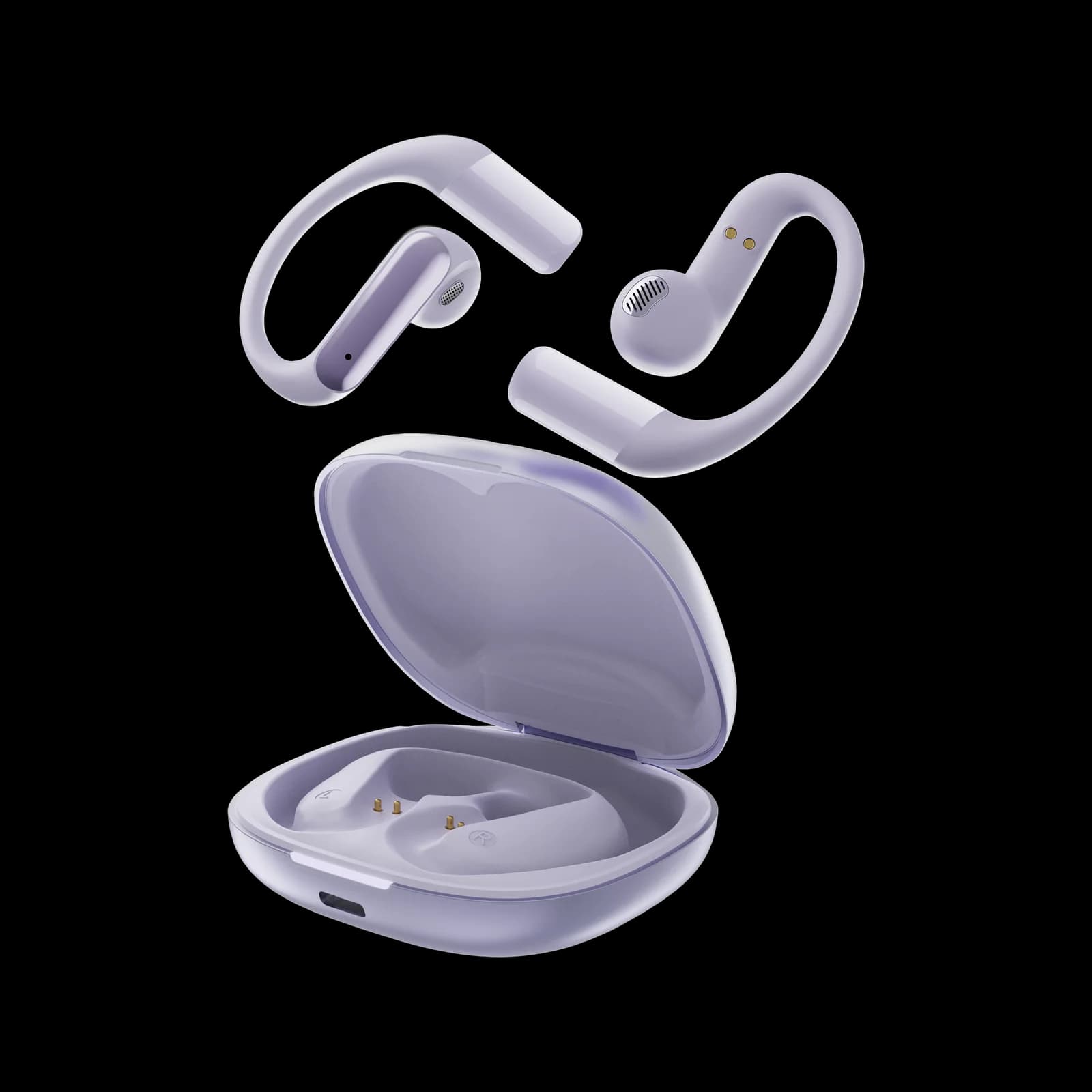
One model carries a water rating: the W12 clip-on, at IPX5. That's a manufacturer-rated figure from our own spec sheet, and it refers to the buds, not the case.
Nothing else in the catalogue carries an IP rating, and I'm not going to let a good number travel. The G129 ear-hook model has FCC and CE documentation, which says nothing about water. The V18 sleep model is built for a dry pillow. If you're buying a different model, ask for that model's test report rather than assuming the range shares the W12's result — compliance and ingress ratings both follow the product, not the factory.
Even on the W12, the IPX5 figure is manufacturer-rated and means what it says: resistance to low-pressure jets. It is not waterproof, and it is not a licence to swim. Where the water lands also depends on the housing: an open-ear clip leaves an acoustic opening facing the room by design, the trade we describe in the design notes for the W12 platform.
Five checks before you trust a water claim
Ask which level, and for the report. "Water resistant" is not a level. The report names the rig, the duration and the laboratory.
Ask whether it covers the buds, the case, or both. Most listings are silent, and the answer is usually buds only.
Ask about salt. If sweat is the real exposure, a fresh-water test is a proxy, not a match.
Check the charging port's condition. A worn gasket or a bent pin voids the argument regardless of the rating.
Read the exclusion list. Almost every rated bud excludes swimming, showering, and charging while wet. Those exclusions are the honest part of the datasheet.
If the actual worry is sweat rather than water, the rating is the wrong lever. Choosing earbuds by workout type starts from the activity and works back to the hardware, which is a more useful order for anyone whose exposure is an hour of training five times a week.
Frequently asked questions
Can I shower with IPX5 earbuds?
No. X5 is a jet test measured in minutes, not a continuous warm deluge with soap in it. Shower steam also condenses inside a housing in a way no spray rig reproduces. If showering matters, you need a manufacturer who explicitly says so, not a digit you've interpreted.
Can I swim with IPX7 earbuds?
Not on the strength of the rating. X7 is 30 minutes at one metre of static fresh water, tested once on a sample. Swimming adds depth changes, chlorinated or salty water, and repeated cycles. Waterproof is a word the standard avoids, and so should you.
Is IPX5 better than IPX4?
For jets, yes; for your actual week, maybe not. X4 covers splashes from any direction, which is most of what rain and sweat do. X5 buys you resistance to a directed spray, which matters if you hose the buds down or ride in weather.
Does IPX5 mean sweatproof?
It means the sample survived a five-minute jet of fresh water. Sweat is saline and continuous, and the failure it causes most often is corrosion on the charging contacts rather than water inside the shell. Treat the rating as one input, not a verdict.
Do I need to dry the charging case?
Yes, and the case is the weak link in most routines. Water carried in on the buds transfers to the pins inside the case and stays there. A dry cloth on the contacts before docking costs four seconds and prevents most of the corrosion I've seen on returned units.
Sources
IEC, Ingress Protection (IP) ratings — the two-digit structure, the 0–9 liquid scale, and the pointer to IEC 60529 for test conditions.
IEC 60529 — the standard itself; the test parameters in the table follow its water-test clauses.
Our own W12 specification sheet — IPX5, buds only, manufacturer-rated.
Our G129 compliance file — FCC and CE documentation; no ingress rating claimed.
Editorial publication note: The IPX5 figure is manufacturer-rated and applies to the W12 buds only. Test conditions in the table are the standard's conditions, not our measurements; we have run no ingress testing ourselves and hold no report beyond the W12 rating. No statement here should be read as a claim that other models share that rating, and nothing in the article covers salt-fog or sweat testing, which we have not commissioned.