
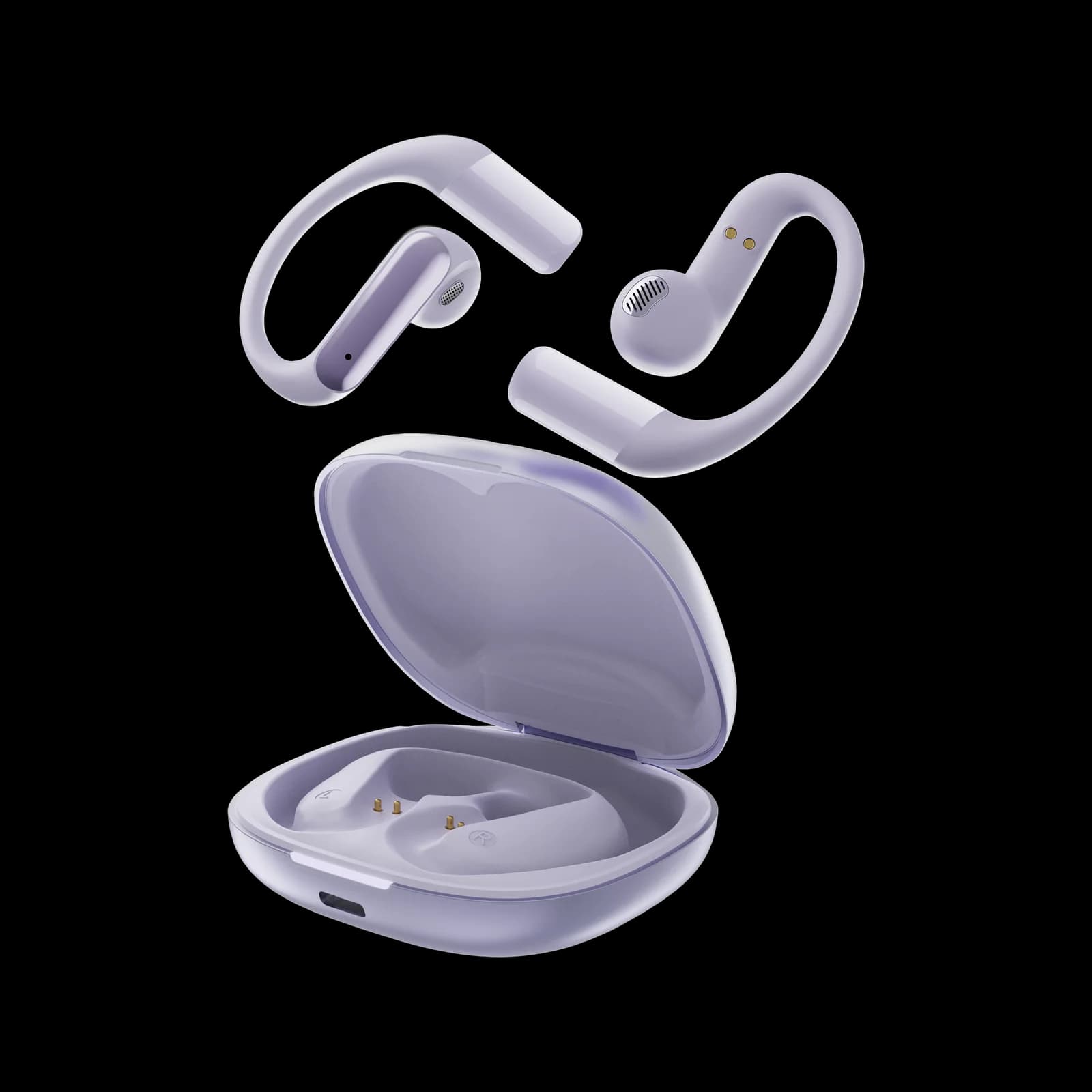
Yes, you can sleep in earbuds. People do it every night and wake up with nothing worse than a dent in the pillow.
What decides whether it stays harmless isn't the brand or the price. It's three dull things: how the bud touches your ear for eight straight hours, how loud it runs for those hours, and what was already on the mesh when you put it in.
Is it safe to sleep with earbuds in?
There's no standard for overnight wear. Limits exist for sound dose and for device construction, but nothing certifies "eight hours in a sealed ear canal". So the answer is conditional rather than yes or no.
Two clinical facts frame the risk. A review of otitis externa — outer-ear infection — names excessive moisture and trauma as its two most common precipitants, and avoiding both as the cornerstone of prevention (American Family Physician). A sealed bud supplies exactly those two: trapped moisture, and pressure from something inserted.
The counterweight matters as much. A recent case-control study of 160 otomycosis patients against 320 controls found frequent earphone or hearing-aid use *not* significantly associated with the fungal infection; habitual ear picking (odds ratio 2.748) and salon cleaning (7.434) were (PubMed 41549957). Put crudely, the bud is a smaller suspect than the cotton swab you scratch the itch with.
What happens when you wear earbuds all night?
Seal a canal for eight hours and you've made it a small warm room with no window. Skin softens, wax softens, airflow stops.
Then there's the occlusion effect. Once an in-ear device seals the canal, low-frequency pressure from your own voice, breathing and swallowing gets amplified inside it — documented in earplug research as a source of discomfort and of a distorted sense of your own voice (PubMed 35778167). That's why some people genuinely cannot sleep in sealed buds. You will hear your heartbeat, and for a certain kind of sleeper that ends the experiment.
What changes | What it feels like at 3 a.m. | Who notices most | What helps |
|---|---|---|---|
Moisture under a seal | Damp, itchy canal by morning | Sealed in-ear wearers, warm rooms | Ventilated shape, dry the tip, air the canal before reinserting |
Occlusion effect | Your breath and pulse sound loud | Light sleepers, side sleepers | Shallower insertion, open-ear shape |
Sustained pressure on cartilage | Soreness at the contact point | Side sleepers, tight clips | Lower clamping force, smaller shell |
Wax pushed toward the drum | Muffled hearing that clears slowly | Anyone inserting deep | Wipe the tip, stop pushing it in |
One item the table leaves out: battery heat. A cell in our range is rated at 30 mAh and trickles out over hours; the warmth you notice is your own body heat with nowhere to go. We're not aware of overnight burn injuries from earbud cells and won't invent a hazard to fill the row.
In-ear vs. open-ear: different contact and fit risks
The two shapes fail differently, and the difference decides which risk you're taking.
Sealed in-ear | Open-ear clip | |
|---|---|---|
Canal | Sealed, warm, unventilated | Open and ventilated |
Main physical risk | Moisture and pressure inside the canal | Pressure on cartilage outside it |
Noise | Passively blocked, so you can listen quieter | Nothing blocked, so volume tends to climb |
Failure at night | Falls out and vanishes into bedding | Stays hooked, but shifts against the pillow |
Best for | Noisy rooms, partner snoring | Quiet rooms, canal sensitivity |
Here's the trade nobody prints on a spec sheet: you can have a ventilated canal or a low listening level, but not both, unless the room is already quiet. Seal the ear and the noise floor drops, which lets you run the bud quietly — the canal pays in moisture. Clip it open and the canal breathes, but nothing stops the room getting in, so the dial creeps up to compensate. That's a dose problem wearing a comfort costume.
In a quiet bedroom, open-ear at low volume is the easier bargain. To mask a snoring partner you need attenuation first, which means a sealed fit — that belongs to matching volume to the noise level. Our sealed sleep model is the V18 in-ear; the W12 clip-on is the other side of the trade.
Does listening volume matter during sleep?
More than anything else here. Damage is a dose — level multiplied by time — and sleep is the longest uninterrupted dose most people ever take.
The WHO-ITU safe listening standard sets a reference exposure of 80 dB for 40 hours a week for adults, and 75 dB for children over the same weekly window (WHO, 2019). Eight hours a night runs to 56 hours a week — 40% more listening time than that WHO-ITU adult allowance, before you touch the dial.
Find the quietest level that still does the job and leave it there. The right volume is the one you'd find slightly annoying while awake.
Use a sleep timer if the audio is only there to get you under. Falling asleep at a masking level and staying there for seven more hours is the expensive version.
Prefer steady content — pink noise, rain, a long ambient track — over music. You turn music up because the quiet passages disappeared, not because it was too loud.
Don't re-crank at 2 a.m. Hearing adapts within minutes, so the level that suited bedtime feels too quiet, and the second setting is always higher than the first.
We don't publish a dB output figure for our buds and don't run dosimetry, so we won't hand you a "safe volume number". Any brand that does, without a measurement method attached, is guessing in your direction.
Can earbuds stay in place when you turn over?
Mostly, and "mostly" is the honest word. A pillow compresses your ear against your skull, and any shell with height becomes a lever.
We tested this on our own clip-on: one tester, one pillow, both sides, one night. It held through roughly ten position changes before shifting enough to notice, and stayed hooked when it moved. That's a sample of one, not a promise.
When they do move, a sealed in-ear ends up in the bedding — which is how people lose buds. A clip stays attached, so it's a comfort problem rather than a lost-object one. If you already turn over a lot, the comfort side is covered in sleeping on your side with earbuds in, and the format question in the comparison of sleep formats.
How to clean earbuds before and after sleep
A nightly-worn bud needs a routine, because eight hours of contact gives anything on the mesh time to become a culture.
Wipe the tip and mesh every morning, dry. A microfibre or soft brush, not a fingernail.
Brush the mesh, don't press into it. Pushing debris through is how a bud starts sounding muffled three months in.
Isopropyl on a cloth, never poured. No liquid into the nozzle or the mic port.
Let the canal side air-dry before it goes back in. A damp bud in a damp ear is the moisture problem done twice.
Replace silicone tips on a schedule. They harden, crack and stop sealing, and a leaking tip pushes you to raise the volume.
One rating trap worth naming: IPX5, which our W12 carries, means resistance to low-pressure water jets. It does not mean you can rinse a bud under the tap or leave it wet in a closed case. Ratings describe a test, not a habit.
When should you stop wearing earbuds overnight?
Some mornings tell you to quit. The list is short:
Pain that lasts past the first hour awake instead of fading when the bud comes out.
Discharge, or a canal that feels wet when nothing went in it.
Itching that doesn't settle within a day or two.
Muffled hearing that doesn't clear after an hour, which usually means wax has been packed against the drum.
New ringing, or fullness that persists after you stop.
Broken skin behind the ear where a clip sits.
Stop for a week; if it hasn't settled, see a clinician rather than adjusting your routine. None of this is medical advice.
There's a non-medical reason to stop too: if masking your room needs a volume you wouldn't accept while awake, the room is the problem. Earplugs for the noise plus a separate plan for the snoring beat one device asked to do both jobs.
Frequently asked questions
Can you sleep with earbuds in every night?
Most adults can, if the fit doesn't press into the canal, the volume keeps the weekly dose sane and the tips get cleaned daily. The people who shouldn't are those with a history of outer-ear infections, narrow or sensitive canals, or skin that breaks down under a clip.
Do earbuds damage your ears if you sleep in them?
The dose and the insertion are the real problems, not the device. Moisture and trauma are the recognised precipitants of outer-ear infection, and a sealed canal for eight hours supplies both. Volume is the bigger lever over years, which is why the WHO-ITU figure is a weekly budget rather than a nightly limit.
Is it safe to sleep with noise-cancelling earbuds?
ANC lets you listen at a lower level, which is a real advantage for dose. It also won't help you hear a smoke alarm or a crying child, so if those matter, use one bud or an awareness mode. ANC is a volume tool, not a safety feature.
Can an earbud get stuck in your ear?
It happens, usually with a tip that has separated from a deep-insertion bud, and it's a clinic visit rather than a DIY project. Tweezers in a canal push things deeper and scratch skin — the trauma the otitis review warns about. Prevention is boring: check the tip is seated, and don't sleep in a bud whose tip is already loose.
Should children sleep with earbuds in?
The WHO-ITU standard sets the child reference at 75 dB for 40 hours a week, lower than the adult figure, and a child's canal is smaller and more easily irritated by a sealed fit. Overnight wear isn't something we'd recommend for children; if a child needs help sleeping through noise, solve it at room level.
Sources
WHO — Safe listening devices and systems: a WHO-ITU standard (2019): reference exposure of 80 dB for 40 hours per week for adults, 75 dB for children.
American Family Physician — Otitis externa: a practical guide: excessive moisture and trauma as the two most common precipitants.
PubMed 41549957 — Otomycosis case-control study: 160 cases and 320 controls; earphone use not significantly associated, ear picking (OR 2.748) and salon cleaning (OR 7.434) were.
PubMed 35778167 — Objective occlusion effect induced by earplugs: low-frequency amplification inside a sealed canal.
Nevoks W12 overnight log, 6 November 2026: one tester, one pillow, roughly ten position changes before the clip shifted noticeably.
Editorial publication note: The hearing-dose figures come from the WHO-ITU standard and the clinical statements from the three papers cited above, all opened on 14 November 2026. The W12 retention figure is first-hand from one tester and one ear shape; it is not a general retention claim and must never be quoted as one. Battery capacity, playback time and the IPX5 rating are manufacturer figures. We ran no dosimetry, thermal measurement or clinical assessment for this article, and nothing here is medical advice.