
Search "sleep headphones" and you'll be shown at least four unrelated products: flat in-ear buds, fabric headbands with speakers sewn in, noise-masking earbuds that can't stream music, and foam earplugs. They are not variations on one idea. They are different answers to different problems, and buying the wrong one is the most common reason people give up on overnight audio entirely.
The useful question is not "which is best." It is: what are you actually fighting at night? A snoring partner, a thin wall, a mind that won't shut off, and a sore ear canal are four different problems with four different fixes.
What lateral pressure does to an earbud
Lying on your side changes the physics of wearing anything in your ear. Upright, an earbud only has to hold itself in. Against a pillow, the pillow pushes back, and every millimetre of housing that protrudes past your ear becomes a lever pressed into cartilage for hours.
Three dimensions decide whether that becomes painful:
Housing height. How far the shell stands proud of the ear rim. A stem-style earbud is the worst case; a flush, low-profile shell is the best.
Contact area. A small hard point concentrates force; a broad soft surface spreads it. This is why headbands work despite zero acoustic isolation.
Tip size and depth. An oversized tip presses outward from inside the canal, which stacks on top of pillow pressure.
SoundGuys' 2026 sleep-headphone guide puts it bluntly: ordinary earbuds are miserable to sleep in unless you lie still on your back. Their side-sleeper picks are built around this constraint — the Ozlo Sleepbuds 2 measure about 11 mm per bud and 1.6 g, small enough to sit flush rather than protrude. That is a design decision, not a marketing one.
Four formats, compared without flattery
Format | What it solves | What it costs you | Best for |
|---|---|---|---|
Regular true wireless earbuds | Nothing specific to sleep | Protrudes into the pillow; sore ears within an hour for side sleepers | Back sleepers, naps, falling asleep then removing |
Dedicated sleep buds (low-profile, often with on-board sounds) | Flush fit, all-night runtime, masking audio | Price; often no ANC; limited or no music streaming | People who wake from noise and want it handled in-ear |
Fabric headband with flat speakers | Zero canal pressure, washable, can double as eye mask | Almost no isolation; modest audio; warm in summer | Sensitive canals, back sleepers, podcast listeners |
Foam or silicone earplugs | Actual attenuation, cheap | No audio at all; can feel occluded | Blocking a specific noise, alone or under other audio |
A fifth option — bone conduction headbands — avoids the canal entirely, at the cost of bass and, in most models, a band pressing across the head.
None of these is "the best sleep headphone." Each row in that table is a trade you are choosing to make.
What the professional reviews converge on
Across the 2026 round-ups, three findings repeat often enough to treat as settled:
Flush beats small. Total size matters less than how far the shell stands out. Two buds of similar volume can differ completely in pillow comfort.
Active noise cancellation is frequency-specific. SoundGuys' lab measurements put the useful ANC band at roughly 20–200 Hz — the low rumble where traffic, air conditioning and snoring live. ANC does little for a door slamming or a dog barking.
Fit decides the review. The same model collects both "invisible" and "unbearable" verdicts, usually depending on tip and wing size.
Point three is the one buyers skip. Ten minutes spent trying every included tip is worth more than any spec comparison.
Where open-ear clips fit — and where they don't
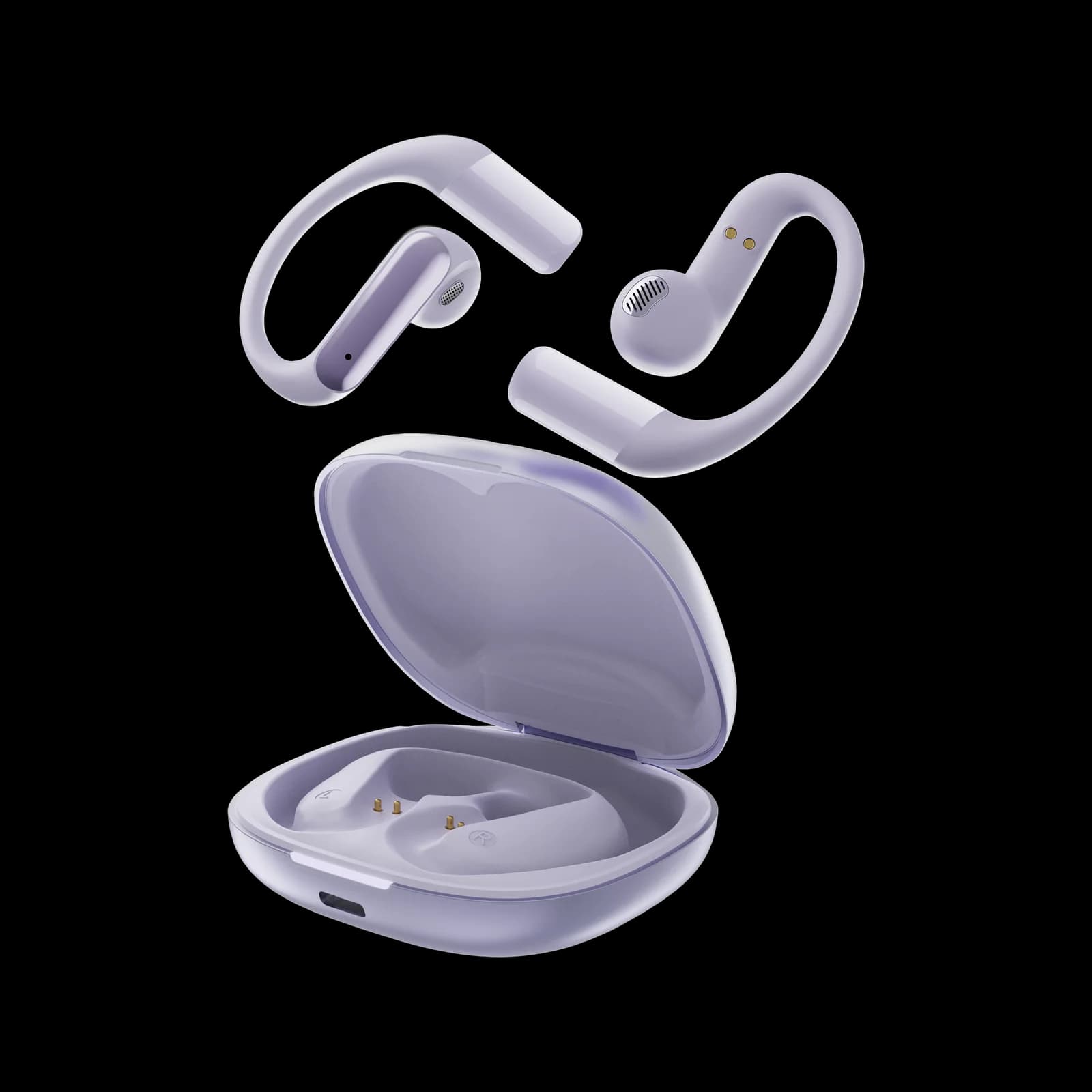
Clip-on open-ear earbuds sit around the outer ear rather than inside the canal. That removes two of the three problems above: no tip pressing outward, and nothing inserted to feel occluded by morning.
What it does not remove is contact. The clip still occupies space on the ear, and a pillow can press it. We tested our own W12 clip over a full night on one side: it held through roughly ten position changes before shifting enough to notice, and produced no soreness by morning. That is one tester, one pillow and one ear shape — useful as a data point, not as a promise, and definitely not a claim that clips are the universal side-sleep answer.
What open-ear designs do well at night is keep you aware. If you need to hear a child, a smoke alarm or a partner, a sealed or noise-cancelling bud is working against you. For that specific situation, an unsealed design is the right tool. Our side-sleeper fit guide goes deeper on contact points and pressure.
And if the problem is a snoring partner rather than your own comfort, the fix has two parts: set the volume to match the noise level rather than guessing, and step up to a sealed in-ear design once the snore is loud enough that the required volume stops being comfortable. Do sleep earbuds block snoring works through the volume arithmetic with the measurement data.
Choosing by scenario, not by category
Snoring partner or traffic noise: sealed in-ear sleep buds with masking audio — our V18 for passive attenuation, or an ANC in-ear model such as V8, V20 or V16 Pro once the noise is steady and loud. A headband will not attenuate low-frequency sound.
Light snoring, and comfort matters more than isolation: an open-ear clip at 50–60% volume handles a mild snore; the ceiling is what the volume has to reach.
Sensitive or narrow canals: headband, or an open-ear design that never enters the canal.
Hot sleeper: earbuds over fleece; fabric holds heat.
Need to hear alarms or a child: unsealed design, with volume kept low.
Podcasts to fall asleep: almost anything works, because you are not staying asleep in it. Runtime matters more than isolation — compare per-charge figures, not case totals (how those claims differ).
Restless side sleeper: flush buds or a headband; stem-style buds will lose.
Overnight safety and hygiene
Keep volume modest — overnight exposure accumulates, and the goal is to sit just above the noise you are masking, not to be immersed. Give your ears time without in-ear devices. Wipe tips weekly; replace them when they stop sealing. And regardless of what a product page implies, no earbud can be guaranteed not to fall out across every ear shape, pillow and sleeping position.
Anyone with recurring ear pain, drainage or hearing changes should see a clinician rather than shopping for a different bud shape.
Frequently asked questions
Can you sleep on your side with wireless earbuds?
Yes, if the housing sits close to flush and the tip does not press outward. Stem-style designs are the worst offenders. Test by lying on both sides for twenty minutes before trusting a pair overnight.
Are flat earbuds better for side sleepers?
Flatter shells reduce the lever effect against a pillow, so they are generally more comfortable on your side. They are not automatically comfortable — contact area, material and weight still matter.
Do sleep earbuds block snoring?
Only if they seal the canal and, ideally, add low-frequency cancellation or masking. Headbands and open designs do not block snoring. Earplugs remain the most effective non-electronic option.
Are regular earbuds safe to wear overnight?
Moderate volume and clean tips make occasional overnight use low-risk for most people. Prolonged canal occlusion can cause irritation, so if your ears feel sore or damp by morning, switch format rather than pushing through.
Sources
SoundGuys, *The best headphones for sleeping in 2026* (lab measurements of ANC band, per-bud dimensions): https://www.soundguys.com/best-headphones-for-sleeping-2-164435/
SoundGuys, *Ozlo Sleepbuds 2 review* (1.6 g per bud, 11 × 17 × 12 mm, isolation data): https://www.soundguys.com/ozlo-sleepbuds-2-review-161143
Editorial publication note: Third-party figures are attributed to SoundGuys and reflect their published test conditions. The W12 overnight observation is a documented first-hand test (November 6, 2026, single tester, both sides, one pillow). Do not convert that single result into a general comfort claim.