
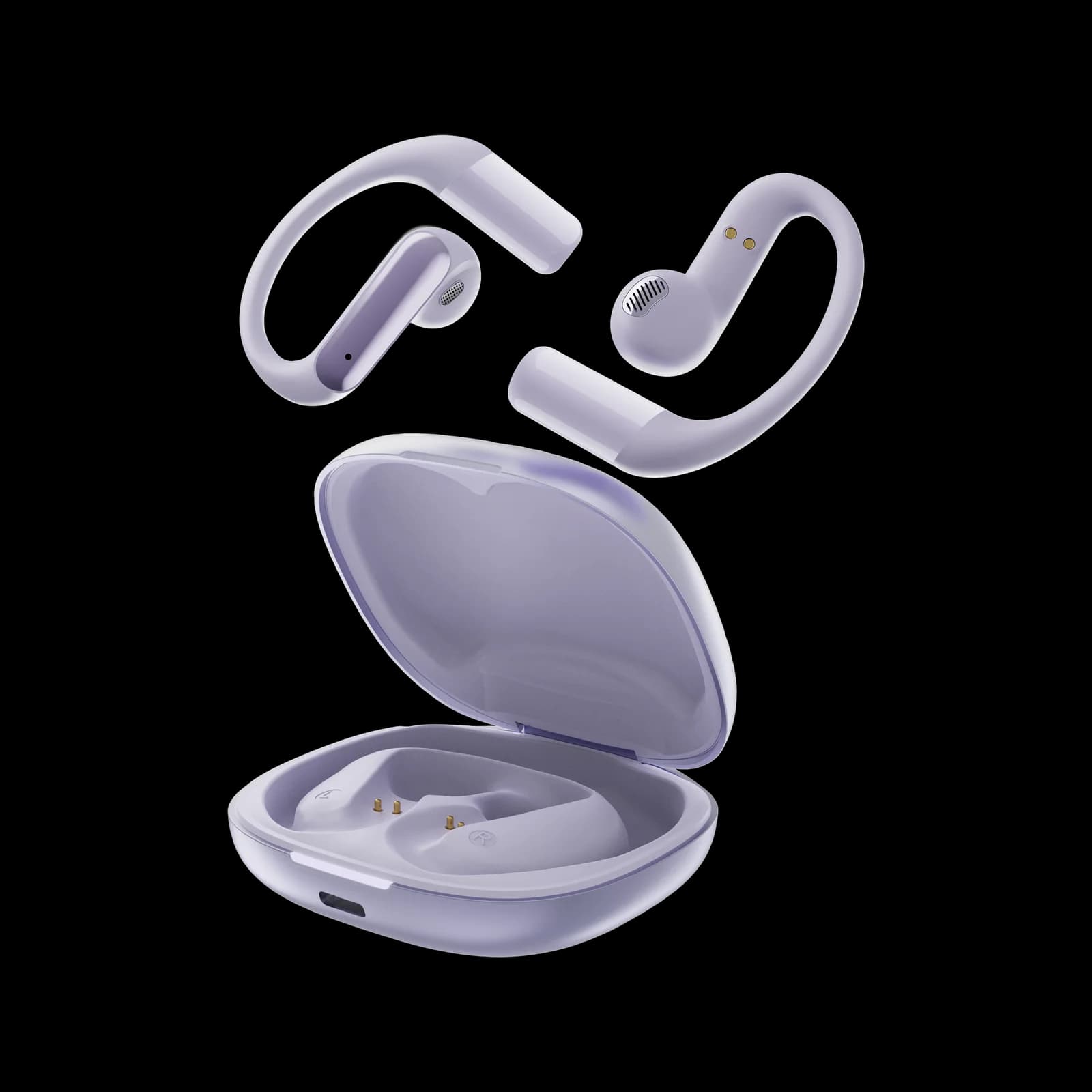
"Invisible" is the most abused word in the earbud category. It is not a specification — there is no standard, no test, and no definition of the distance at which invisibility is supposed to hold. Two products both called invisible can differ completely: one disappears at arm's length in dim light, the other is obvious from across a room.
The useful move is to stop asking whether a bud is invisible and start asking invisible to whom, from where, in what conditions.
The three variables that decide it
Distance. At 30 cm, almost anything reads as skin. At three metres, silhouette and colour dominate and detail disappears. Workplaces sit in the awkward middle: a metre or two, in indoor light, from an angle.
Contrast. A white stem against a dark ear is the highest-contrast combination there is — which is exactly why stem-style earbuds read as "earbuds" instantly. A black shell against dark hair is low contrast. A skin-tone shell is low contrast against skin but can look like a patch of discolouration, which is arguably worse if someone is looking directly.
Silhouette. The shape matters more than the size. A small bud that protrudes from the ear canal still creates the recognisable "earbud" outline. A flush or wrapped design that follows the ear's own curve does not.
Claim audit: what each phrase usually means
Claim on the listing | What it typically means | How to check |
|---|---|---|
"Invisible design" | Small, and photographed from a flattering angle | Look for a side-profile photo, not a front view |
"Mini / smallest" | Smaller than average for its class | Compare published dimensions in mm, per bud |
"Hidden under hair" | Requires long, loose hair | Consider your own hair length and styling |
"No one will notice" | Untestable marketing | Ignore it; find user photos in the same lighting |
"Discreet for office" | Subjective, occasionally accurate | Ask whether the shape protrudes past the ear rim |
The reliable signal in that table is the last column: published dimensions and honest side-profile photography. A brand that shows the bud from the side, on an ear, is telling you something you can evaluate. A brand that only shows a floating product shot is selling a mood.
The size-versus-runtime trade
Physics does not negotiate. A smaller shell holds a smaller battery. In this category that shows up as a wide spread of real-world runtimes, and the marketing rarely separates "per charge" from "with case."
If an invisible bud claims 20 hours, the bud-only figure is probably 4–6 and the rest is case top-ups. That number is not dishonesty, but it does not answer "will it survive my shift" — which is the question you actually have. Our breakdown of what those battery claims measure applies directly here.
Our own W12 sits at 4.5–6 hours per charge with a 300 mAh case, which we state as a manufacturer figure and separately mark as tested: about five hours of continuous playback at 50% volume. That is a normal result for a shell this size, and worth comparing against anything advertising "all-day."
Where clips change the silhouette
Open-ear clip designs do not enter the canal, so they do not create the protruding-bud outline. What they create instead is a thin band around the ear rim. In dark colours and at conversational distance, that reads as part of the ear far more readily than a stem does.
It is not invisible. It is low-contrast and unremarkable, which is the practical goal. If you want to see what we mean by measured rather than claimed, the W12 product page lists per-unit dimensions and the full specification — and our workplace guide to low-profile options covers the etiquette side, including the fact that a bad microphone reveals you faster than a visible earbud does.
What actually gets people caught
Not the earbud. Three other things:
The charging case on the desk. The case is the most recognisable object in the kit.
A call on a weak mic. Everyone within earshot hears both sides of the conversation.
Reacting visibly. Nodding to music, laughing at a podcast, or answering a question twice because you didn't hear it.
If your workplace tolerates headphones, none of this matters. If it doesn't, the earbud's colour is the least of your problems.
Before you buy
Find per-bud dimensions in millimetres, not adjectives.
Find a side-profile photo on an ear.
Check the per-charge runtime, not the case total.
Confirm the return policy — fit and appearance are the two things you cannot judge from a listing.
If your ears are small, read the fit guidance first: small ears change which shells work, independent of how invisible they look.
Frequently asked questions
Are invisible earbuds actually invisible?
No. They are small and low-contrast enough to go unremarked at conversational distance in many settings. Nothing is invisible from every angle in every light.
What are the smallest earbuds?
Sleep-focused buds are currently the smallest category, with per-bud weights around 1.6 g and shells roughly 11 mm. Mini TWS designs come next; traditional earbuds with stems are the largest.
Do invisible earbuds have worse sound?
Smaller shells usually mean smaller drivers and less bass, and often less battery. That is a design trade, not a defect — but it is worth knowing before you expect full-size sound.
Are they allowed at work?
That is a policy question, not a product one. Many workplaces restrict earbuds in customer-facing or safety-sensitive roles regardless of size. Check the rule, not the listing.
Sources
SoundGuys, *The best headphones for sleeping in 2026* (per-bud dimensions and weight for the smallest current designs): https://www.soundguys.com/best-headphones-for-sleeping-2-164435/
Editorial publication note: W12 specifications cited (4.5–6 h per charge, 300 mAh case, ~55 g kit) are manufacturer-rated; the ~5 h continuous playback result at 50% volume is a first-hand test recorded November 6, 2026. Avoid repeating "invisible" as a product claim in our own copy — describe silhouette and contrast instead.